


Jason Salmon, CFP®, CSS, Wealth Planner
jsalmon@haverfordquality.com
5 Things to Consider for Medicare Open Enrollment
Each year from October 15 through December 7, Medicare enrollees can review and change their health and prescription drug coverage for the following year. During open enrollment, beneficiaries can switch Medicare Advantage plans; move between Original Medicare and Medicare Advantage; and join, drop, or switch Medicare drug (Part D) plans, depending on their current coverage.
This is also the time of year consumers are flooded with Medicare Advantage advertisements promoting low premiums and the benefits of switching plans. With so many options and confusing terminology, doing nothing may seem easiest. However, automatically renewing without reviewing your coverage could affect both your wallet and your access to care. Here we provide a helpful framework to guide your open enrollment decision making:
1. Is Original Medicare plus Medigap or Medicare Advantage right for me?
Deciding between Original Medicare—with or without a supplemental Medigap policy—or Medicare Advantage comes down to evaluating the tradeoff between cost, coverage, and access. For most beneficiaries with sufficient Medicare-covered employment, Part A (hospital insurance) has no monthly premium. However, Part B (medical insurance) and Part D (prescription drug) require premiums, and higher-income beneficiaries may pay more because of the Income-Related Monthly Adjustment Amount (IRMAA). Additional costs may be incurred if an optional Medigap policy is added to help with Original Medicare cost sharing or if private standalone insurance is purchased for dental, vision, or hearing services.
Medicare Advantage, also called Part C, is offered by Medicare-approved private insurers as an alternative way to receive Part A and Part B benefits. Most plans include Part D prescription drug coverage, and many offer additional benefits such as dental, vision, hearing, or fitness benefits. Some plans have a $0 additional monthly premium, but beneficiaries must still pay their Part B premium.
While Medicare Advantage may seem like a more economical solution, the tradeoff is these plans can manage or restrict access to benefits through provider networks, referrals, prior authorizations, and plan-specific copays or coinsurance. For people who need to see doctors regularly, Original Medicare may be a better option. Which plan is best for you depends on affordability, your healthcare utilization needs, and your flexibility in choosing doctors.
2. Has my current plan changed?
Original Medicare’s core structure generally remains consistent, although premiums, deductibles, coinsurance amounts, and IRMAA thresholds can change annually. Medicare Advantage requires a closer annual review since each private insurer can change its plan design from year to year. Important items to review include:
- Monthly plan premium
- Deductibles, copays, and coinsurance
- Annual maximum out-of-pocket limit for covered Part A and Part B services
- Prescription drug formulary and cost sharing
- Provider, pharmacy, and hospital networks
- Prior-authorization or referral requirements
- Dental, vision, hearing, fitness, and other supplemental benefits
Medicare Advantage and Part D members should review the Annual Notice of Change each fall before assuming next year’s coverage will be identical to the current year.
3. Are my prescriptions still covered affordably?
Evaluating prescription costs is more involved than simply reviewing the monthly Part D premium. The deductible, copays or coinsurance, preferred pharmacies, and the total annual cost of your medications should also be considered.
Equally important is the plan’s drug formulary, which is the list of covered prescription drugs. Formularies can change, so you should review coverage for your medications during open enrollment even if you are satisfied with your current plan.
4. Are my doctors still in-network?
There are two important questions to review each year:
- Does my doctor accept Medicare?
- For Medicare Advantage, does my doctor participate in my specific plan and network for the coming year?
With Original Medicare, beneficiaries can generally visit any doctor or hospital in the U.S. that accepts Medicare. With Medicare Advantage, access can vary because plans typically use contracted networks of physicians, specialists, hospitals, and other providers. Plans offered by the same company may even utilize different networks.
If your provider leaves a Medicare Advantage network, the financial impact depends on the type of plan. PPO plans may cover out-of-network services at higher cost sharing while HMO plans generally do not cover routine out-of-network care except in limited circumstances such as emergencies. Medicare.gov offers helpful plan comparison tools. For Medicare Advantage, check the insurer’s provider directory or contact your doctor’s office to verify plan participation. Be sure to verify your entire care team is in network, including specialists and hospitals.
5. What will my total healthcare costs actually be?
When evaluating Medicare coverage, a useful framework is:
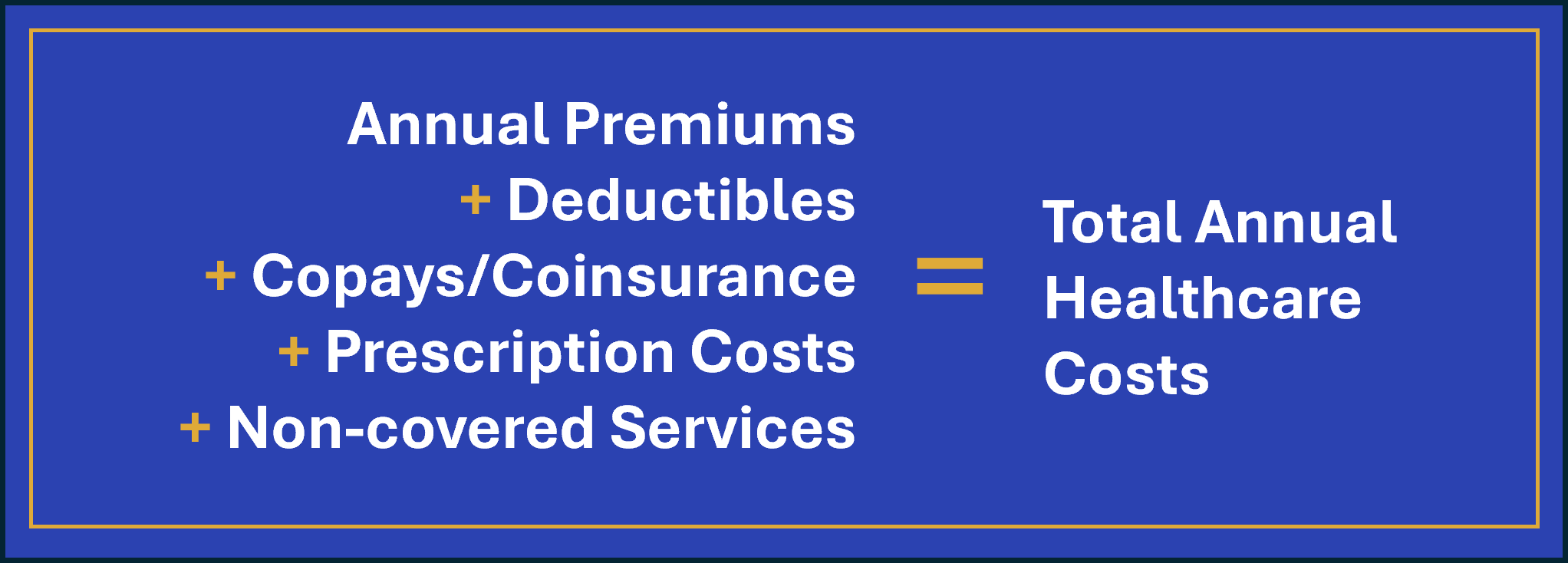
Medigap can materially change the Original Medicare cost calculation. For example, Medigap Plan G generally pays the Part B coinsurance after the annual Part B deductible is met.
Medicare Advantage, by contrast, has plan-specific deductibles, copays, and coinsurance and includes an annual maximum out-of-pocket limit for covered Part A and Part B services. It may be more realistic to compare Original Medicare + Part D + Medigap with Medicare Advantage while also taking into account both expected annual costs and potential costs in a high-utilization year.
Make the Most of Open Enrollment
The best Medicare choice is highly individual. Your specific health needs, preferred providers, travel patterns, budget, and tolerance for unpredictable out-of-pocket expenses should all be part of the decision. Taking the time to review these five areas during open enrollment can help you choose personalized, appropriate coverage for the coming year.
The information provided is not intended to be and should not be construed as legal or tax advice or a legal opinion. Haverford does not provide legal or tax advice. You should contact your legal or tax advisor regarding your specific tax situation prior to taking any action based upon this information.
Media Inquiries
Veronica McKee, CMP
Direct Phone: 610.995.8758
Email: vmckee@haverfordquality.com
Katie Karsh
Direct Phone: 610.755.8682
Email: katie@gobraithwaite.com
Disclosure
These comments are provided as a general market overview and should not be relied upon as a forecast, research or investment advice, and is not a recommendation, offer, or solicitation to buy or sell any securities or to adopt any investment strategy. Opinions expressed are as of the date noted and may change at any time. The information and opinions are derived from proprietary and non-proprietary sources deemed by Haverford to be reliable, but are not necessarily all-inclusive and are not guaranteed as to accuracy. Index returns are presented for informational purposes only. Indices are unmanaged, do not incur fees or expenses, and cannot be invested in directly.
Investments in Securities are Not FDIC Insured · Not Bank Guaranteed · May Lose Value
