


Tim Hoyle, Chief Investment Officer
Thoyle@haverfordquality.com
Confidence Low, Spending High – Navigating a K-Shaped Economy
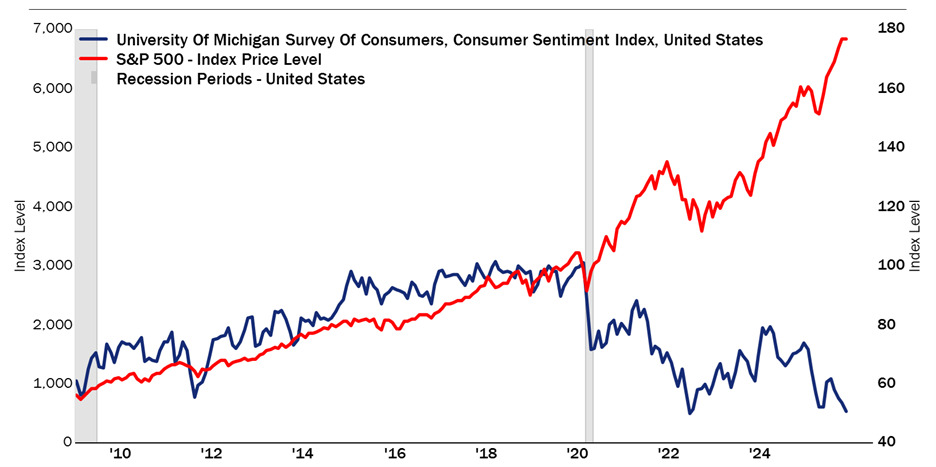
The latest data from The Conference Board shows U.S. consumer confidence fell sharply in November, dropping 6.8 points to 88.7, its weakest reading since April and well below the 100 baseline that signals optimism. The Expectations Index, which gauges the six-month outlook, plunged to 63.2, remaining under the recession-warning threshold of 80 for the tenth consecutive month. As we approach 2026, inflation expectations remain elevated and intentions to purchase big-ticket items have softened. Sentiment deteriorated across most age and income groups, with older households and middle-income earners particularly downbeat.
Despite this pessimism, Black Friday 2025 delivered record-breaking results. Black Friday sales increased 4.1% versus last year, driven by a 9.1% increase in online spending, according to Adobe Analytics. While $11.8 billion was spent online on Friday, Thanksgiving Day online shopping added another $6.4 billion, underscoring strong early-season engagement. The National Retail Federation projects a record $1 trillion in total holiday spending with online sales projected to surpass $250 billion. Mobile commerce dominated, accounting for 56.1% of online revenue, while Buy Now, Pay Later (BNPL) usage surged, expected to hit $20.2 billion for the season—an 11% increase from last year. AI-driven shopping played a pivotal role, with traffic from AI sources up 805% year-over-year, driving billions in sales.
This disconnect between sentiment and spending highlights the reality of a K-shaped economy—a recovery where different segments of society move in opposite directions. The upper arm of the “K” represents affluent households and sectors thriving, buoyed by asset appreciation and strong equity markets, while the lower arm reflects households squeezed by rising costs and stagnant wage growth. Today, the top 10% of earners accounts for nearly 50% of all consumer spending, up from 43% in 2020¹, while the top 40% drive roughly 60% of consumption². These households also control about 85% of U.S. wealth, making their spending highly correlated with market performance. Meanwhile, lower-income consumers are increasingly reliant on credit and installment plans to maintain participation in holiday shopping.
Industries tied to technology, luxury goods, and premium services are flourishing, while sectors dependent on lower-income consumers—such as discount dining and mid-tier retail—face headwinds. This bifurcation is evident in retail data: high-income shoppers are driving growth in luxury apparel and premium travel, while lower-income households are trading down to private-label goods and leaning on BNPL options to stretch their dollars.
The U.S. economy is sending mixed signals—confidence is near recessionary levels, yet spending remains resilient, driven disproportionately by affluent households. For investors, effectively navigating this K-shaped landscape will likely be a critical factor in achieving success in 2026.
graph
Source: Oct 31, 2025. The University of Michigan Consumer Sentiment Survey measures how optimistic or pessimistic consumers are about the economy. The S&P 500 index is a market capitalization weighted index of large cap stocks. For illustrative purposes only. Indices are unmanaged, do not incur fees or expenses and cannot be invested in directly. Past performance is not a guarantee of future results.
Media Inquiries
Veronica McKee, CMP
Direct Phone: 610.995.8758
Email: vmckee@haverfordquality.com
Katie Karsh
Direct Phone: 610.755.8682
Email: katie@gobraithwaite.com
Disclosure
These comments are provided as a general market overview and should not be relied upon as a forecast, research or investment advice, and is not a recommendation, offer, or solicitation to buy or sell any securities or to adopt any investment strategy. Opinions expressed are as of the date noted and may change at any time. The information and opinions are derived from proprietary and non-proprietary sources deemed by Haverford to be reliable, but are not necessarily all-inclusive and are not guaranteed as to accuracy. Index returns are presented for informational purposes only. Indices are unmanaged, do not incur fees or expenses, and cannot be invested in directly.
Investments in Securities are Not FDIC Insured · Not Bank Guaranteed · May Lose Value
Related News & Insights
John F. Thomas, CFA Vice President, Fixed Income Portfolio Manager jthomas@haverfordquality.com Hut, Hut, Hike? [...]

While New Year’s resolutions are likely long forgotten, it is never too late to [...]

Timothy A. Hoyle, Chief Investment Officer thoyle@haverfordquality.com Last Week of August: A Consequential Week [...]
