


Conor Osborne, CFA
Research Analyst
cosborne@haverfordquality.com
The recent earnings reports from Meta, Microsoft, Alphabet, and Amazon reinforced that artificial intelligence (AI) is a strategic imperative reshaping the capital allocation priorities of the world’s largest technology companies. Those earnings reports also served as a mini referendum on the AI build-out and what investors are prioritizing today. Microsoft and Amazon saw their stock surge while Meta’s declined nearly 10%.
Across the hyperscaler group, capital expenditures have risen to levels once considered unthinkable for businesses that historically thrived on asset-light models, robust free cash flow generation, and substantial shareholder returns. Today, those same companies are investing aggressively in data centers, semiconductors, and advanced AI models to secure leadership positions in what they view as a generational technology transition. J.P. Morgan estimates annual hyperscaler capital spending will reach $1 trillion over the next two years, and nearly $1.5 trillion by 2030. At these levels, spending will consume most of these companies’ operating cash flows over the coming years, a remarkable departure from the financial profiles that defined these businesses for much of the last decade.
While the opportunity is substantial, investors have begun to scrutinize how this buildout is being financed. Companies are increasingly utilizing debt markets, joint ventures, project financing vehicles, and equity raises in this pursuit. The dispersion in stock performance highlights that investors are not simply evaluating the magnitude of a company’s AI-related spending, but rather each company’s ability to translate those investments into attractive future returns.
For Meta, the debate remains centered on monetization. The company delivered another quarter of impressive operational performance; however, capital expenditures exceeded $30 billion, contributing to a sharp decline in free cash flow and pressure on operating margins. Management reiterated plans to invest aggressively in frontier AI models and compute capacity while also outlining potential future monetization opportunities beyond social media advertising. Despite strong revenue growth, Meta’s stock sold off as investors focused on contracting profitability without concrete evidence of incremental revenue opportunities driven by AI investments. We’re encouraged by the strong reception to Meta’s first frontier model release, Muse Spark, and we believe there is reason for optimism around future products as the rebuilt AI team scales up computing power.
Microsoft delivered a markedly different message. While the company continues to spend heavily on AI infrastructure, investors were encouraged by evidence that the company can deliver growth using only cash generated from operations. Unlike Meta, Microsoft benefits from its Azure cloud business, which provides a direct sight line between capital spending and enterprise monetization. The positive stock reaction following its earnings announcement reflected confidence that Microsoft’s AI investments are producing accelerating economic returns while burning relatively less cash than competitors.
Amazon’s earnings provided another interesting litmus test for the market. The company’s Amazon Web Services (AWS) cloud unit delivered the strongest growth in nearly five years, and margins continued to improve. CEO Andy Jassey said he believes AWS will “very possibly be a $1 trillion annual revenue business for us in time, with very appealing free cash flow and return on invested capital.” On the other hand, capital expenditure climbed to $220 billion for 2026, and analysts are anticipating material increases over the next two years. Amazon also spent billions in cash for the third consecutive quarter. Investors looked at Amazon’s results and determined the juice was worth the squeeze, triggering the company’s best single-day stock gain since 2012.
Looking at the hyperscalers as a group shows us markets are signaling, for now, that astronomical spending and dwindling cash flow will only be tolerated if there is a clearly defined path to significant return on investment (ROI). While the opportunity in front of these companies remains transformative, the bar for execution continues to rise, and management teams will need to maximize efficiencies to support profitability in the near term. Elevated spending levels leave less margin for error, yet the hyperscalers are among the most innovative and profitable companies in history. We remain confident the companies we have referenced here will remain leaders in this new technology paradigm.
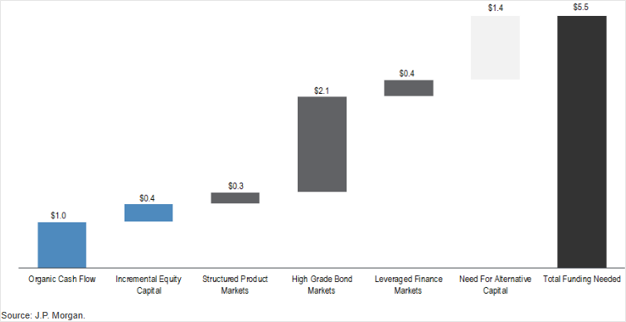
J.P. Morgan forecasts the cumulative funding needs ($5.5 trillion) over the next five years to finance the data center build-out. Hyperscalers are expected to leverage a variety of sources to retain balance sheet flexibility and preserve credit ratings.
Anticipated AI Capex Funding Sources Over Next 5 Years
080626
Source: J.P. Morgan
Media Inquiries
Veronica McKee, CMP
Direct Phone: 610.995.8758
Email: vmckee@haverfordquality.com
Katie Karsh
Direct Phone: 610.755.8682
Email: katie@gobraithwaite.com
Disclosure
These comments are provided as a general market overview and should not be relied upon as a forecast, research or investment advice, and is not a recommendation, offer, or solicitation to buy or sell any securities or to adopt any investment strategy. Opinions expressed are as of the date noted and may change at any time. The information and opinions are derived from proprietary and non-proprietary sources deemed by Haverford to be reliable, but are not necessarily all-inclusive and are not guaranteed as to accuracy. Index returns are presented for informational purposes only. Indices are unmanaged, do not incur fees or expenses, and cannot be invested in directly.
Investments in Securities are Not FDIC Insured · Not Bank Guaranteed · May Lose Value
Related News & Insights
The hype in Artificial Intelligence (AI), what many say, is a modern-day gold rush, is amassing trillions of dollars of investment. A recent UN Trade and Development (UNCTAD) report projects the global AI market will grow from $189 billion in 2023 to $4.8 trillion by 2033; massive gains and insatiable demand is being seen in all corners of the industry.

John F. Thomas, CFA Vice President, Fixed Income Portfolio Manager jthomas@haverfordquality.com Hut, Hut, Hike? [...]

While New Year’s resolutions are likely long forgotten, it is never too late to [...]
