

Tim Hoyle, Chief Investment Officer
Thoyle@haverfordquality.com
SaaS-pocalypse
The S&P 500 has traded essentially flat since first reaching 6,900 in October 2025. Over the subsequent four months, the market index has tested but failed to close above the 7,000 level. The primary obstacle for stocks has not been geopolitical developments, interest rate fluctuations, or economic challenges. Rather, what was previously a significant catalyst—enthusiasm surrounding artificial intelligence—has become a drag for equities.
Adam Crisafulli of market commentator Vital Knowledge believes AI is becoming a net negative for the stock market in three ways:
- Performance of the Magnificent 7 stocks, leaders of the market’s multi-year rally, has stalled as their business models are moving in an undesirable direction. Free cash flow is tumbling thanks to surging capital expenditures, and future margins face headwinds from rising depreciation costs. These factors have led to meaningful market compression.
- Fears that AI will disrupt and ultimately displace entire industries are mounting. The software industry with its wide margins and high multiples was just the first industry to fall into AI’s crosshairs. Anthropic’ s recent release of Claude Cowork sparked fears that data providers, financials, insurance brokers, and legal services companies will ultimately be disrupted. We recommend reading last week’s viral post by Nicolas Bustamente[1] on the erosion of software companies’ competitive advantages due to AI for more on this.
- The surge of data center buildouts has led to a spike in prices for memory (computer storage components). The rapid price increase is hurting margins for technology hardware and consumer electronics makers. High memory prices are likely to lead to price inflation and potentially lower demand for consumer electronics..
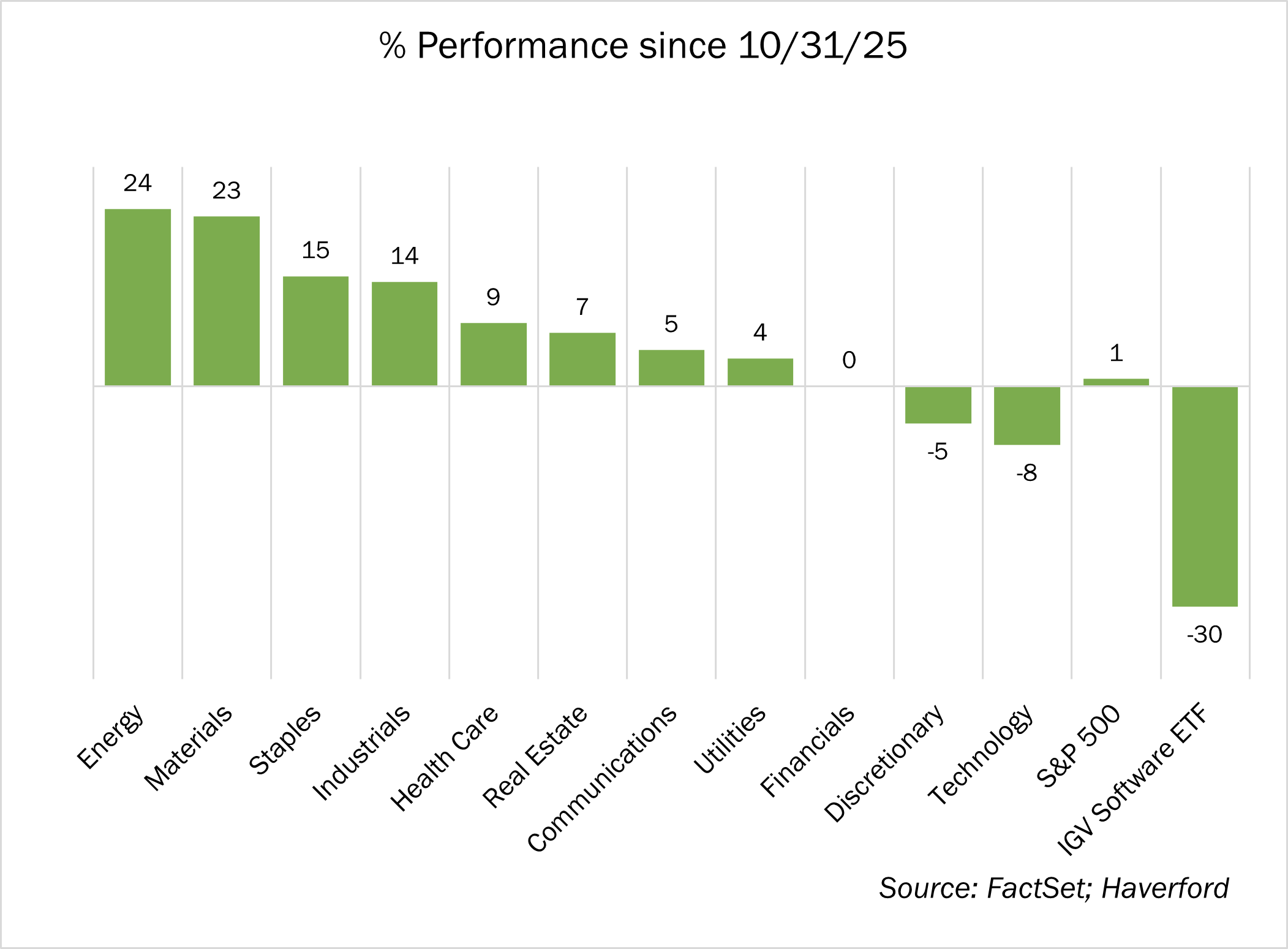
As the Tech sector has pulled back other sectors have catapulted higher to start the year. CNBC contributor Josh Brown calls this the HALO trade, an acronym for Hard Assets, Low Obsolescence. Investors are rotating into “real economy” stocks, meaning those with perceived AI immunity such as Energy, Industrials, Materials and even Consumer Staples companies.
Picture1
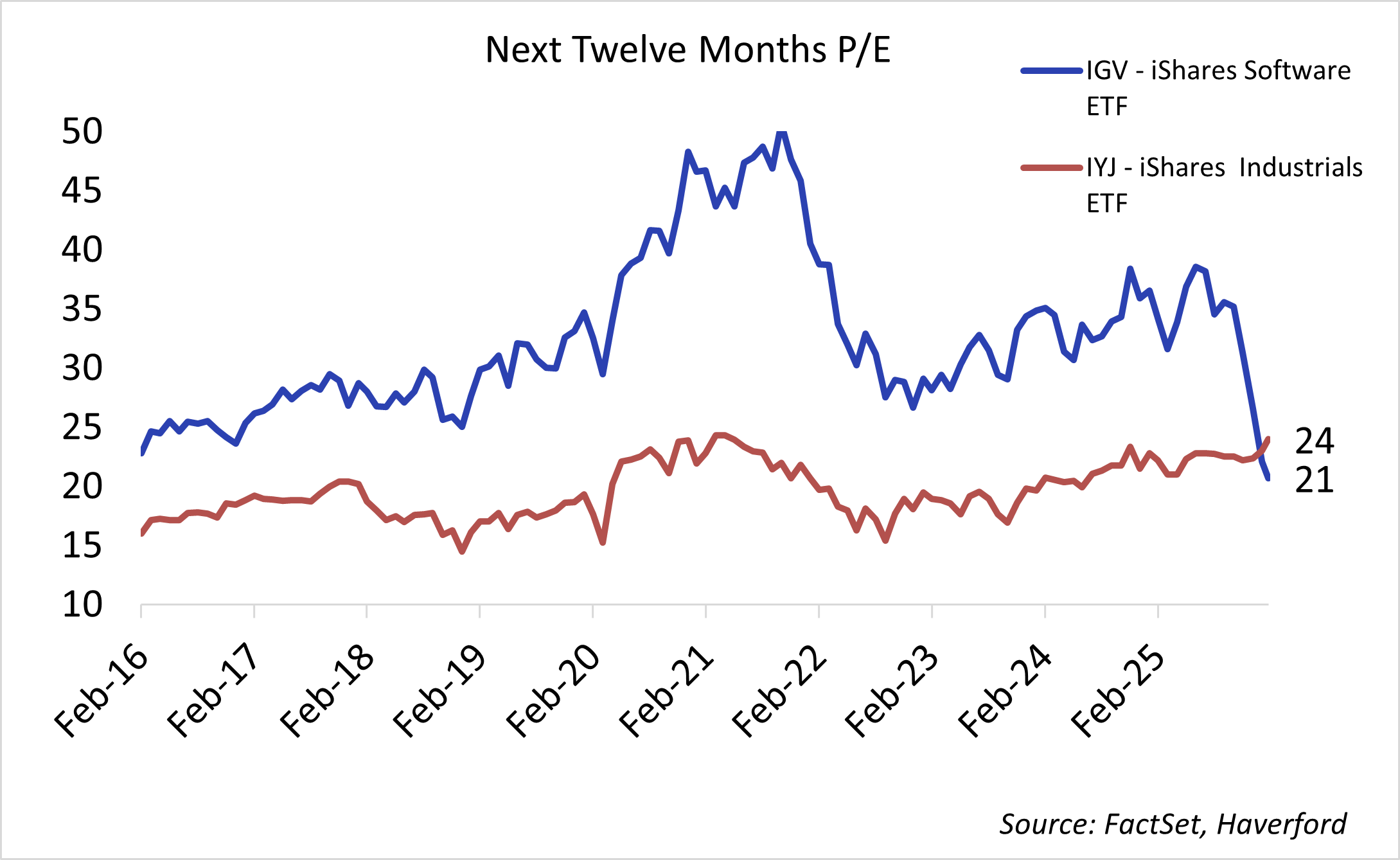
The bear market in software companies combined with the strength of Industrial shares means that for the first time in a very long time, Industrials are more expensive than software companies, despite the significantly faster earnings growth exhibited by software companies over the past ten years. Investors are rightly concerned that AI may significantly disrupt their business models, leading to lower profits over time and more multiple compression.
Picture2
We view the market rotation of the past several months as evidence for the need to remain diversified despite the strength and power of the current narrative.
[1] Nicolas Bustamante on X: “10 Years Building Vertical Software: My Perspective on the Selloff” / X
Graph #1 Disclosure: Source: FactSet, Haverford. The S&P 500 index is a market capitalization weighted index of large cap stocks. For illustrative purposes only. Indices are unmanaged, do not incur fees or expenses and cannot be invested in directly. The iShares Expanded Tech-Software Sector ETF seeks to track the investment results of an index composed of North American equities in the software industry and select North American equities from interactive home entertainment and interactive media and services industries. Past performance is not a guarantee of future results.
Graph #2 Disclosure: The iShares Expanded Tech-Software Sector ETF seeks to track the investment results of an index composed of North American equities in the software industry and select North American equities from interactive home entertainment and interactive media and services industries. The iShares U.S. Industrials ETF seeks to track the investment results of an index composed of U.S. equities in the industrials sector.
Media Inquiries
Veronica McKee, CMP
Direct Phone: 610.995.8758
Email: vmckee@haverfordquality.com
Katie Karsh
Direct Phone: 610.755.8682
Email: katie@gobraithwaite.com
Disclosure
These comments are provided as a general market overview and should not be relied upon as a forecast, research or investment advice, and is not a recommendation, offer, or solicitation to buy or sell any securities or to adopt any investment strategy. Opinions expressed are as of the date noted and may change at any time. The information and opinions are derived from proprietary and non-proprietary sources deemed by Haverford to be reliable, but are not necessarily all-inclusive and are not guaranteed as to accuracy. Index returns are presented for informational purposes only. Indices are unmanaged, do not incur fees or expenses, and cannot be invested in directly.
Investments in Securities are Not FDIC Insured · Not Bank Guaranteed · May Lose Value
Related News & Insights
Tim Hoyle, Chief Investment Officer Thoyle@haverfordquality.com SaaS-pocalypse The S&P 500 has traded essentially flat [...]
-
Tim Hoyle, Chief Investment Officer Thoyle@haverfordquality.com Realpolitik and Populism Set the Stage for 2026 President Trump [...]

Thomas Bayer, Jr., CFP®, MT Senior Wealth Planner One of the greatest gifts or [...]
