


Navigating Volatility: War, Rates and Market Fluctuation in 2026
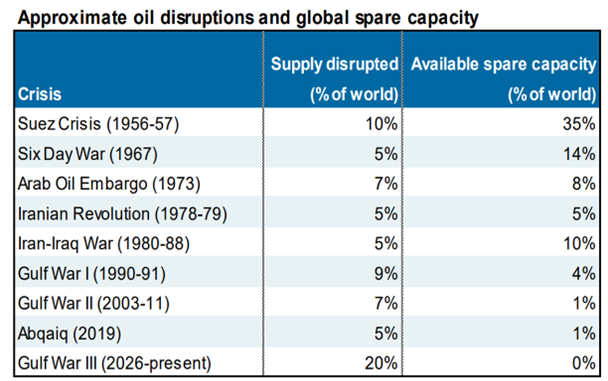
During the first quarter, the stock market faced considerable upheaval and experienced a significant sell-off. The war with Iran has resulted in the greatest disruption to energy markets since the Suez Canal Crisis of the 1950s. Additional concerns over private credit and fears that advances in artificial intelligence may eviscerate software companies intensified the turbulence, making this one of the most uncertain quarters investors have experienced since 2022.
Despite these challenges, we believe the market has demonstrated notable resilience. While 10% price declines are uncomfortable, market participants understand that temporary downturns are a normal part of the investment cycle, especially during periods of elevated uncertainty.
Our Spring Outlook picks up the key themes and critical topics that will play a role in shaping 2026.
Picture1
Source: Rapidan Energy Group, EIA, BP, St. Louis Fed, US Senate, March 9, 2026
Economy
The economy was showing signs of strengthening as we began the year, with fiscal stimulus from the One Big Beautiful Bill Act (OBBBA), falling interest rates, and robust corporate profits expected to drive further growth. Developments in Iran have tempered this outlook but not completely reversed it. The U.S. economy is expected to expand by over 2% in 2026, with consumer spending bolstered by increased tax refunds and tempered by rising energy prices. The AI spending boom has shown few signs of abating, driving the need for capital improvements to critical infrastructure across the country. A weak jobs market is a growing concern. The economy has added only 13,000 jobs per month over the past year; however, the unemployment rate has remained steady as the supply of labor has slowed.
Iran and the Strait of Hormuz
America entered this war with Iran with four goals, none of which were related to the safe passage of ships through the Strait of Hormuz. So far, investors and markets appear to accept the administration’s assurances that mission creep will not lead to escalation and a prolonged conflict, and that potential energy supply disruptions may be manageable for the global economy. However, the longer energy prices remain at or above current levels, the more susceptible the global economy becomes to a recession. The President is most probably and keenly aware that ending this war is imperative for any hopes he has to refocus on his domestic agenda.
The Fed and Interest Rates
Inflationary pressures are building and any plans the Federal Open Market Committee (FOMC) had to cut rates are on hold for the foreseeable future. Unless the economy weakens meaningfully with several months of job losses, we don’t expect a cut in short-term rates. The fed funds futures market isn’t pricing in any cuts until 2027. Kevin Warsh’s appointment to chair the FOMC has removed a significant point of uncertainty. We believe Warsh will be seen as a stabilizing factor, given his experience, pragmatism, and deep knowledge of the financial sector.
Mortgage rates have remained stubbornly high. For a brief moment at the end of February, the weekly Freddie Mac 30-year fixed rate mortgage index had moved below 6% to 5.98%. By the week ended April 2, 2026, that rate had popped back up to 6.46%. These rates continue to dampen housing activity as both new purchases and refinancings are adversely impacted. Getting those rates back below 6% for a sustained period would certainly aid the housing market.
Corporate Earnings
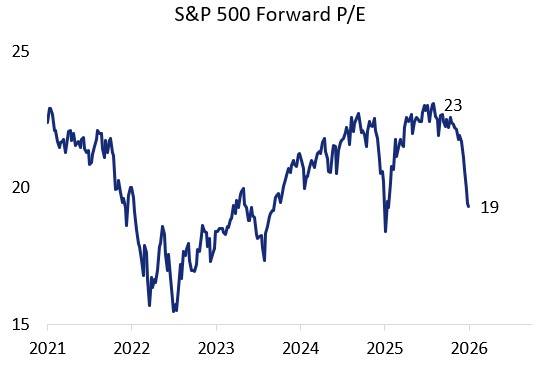
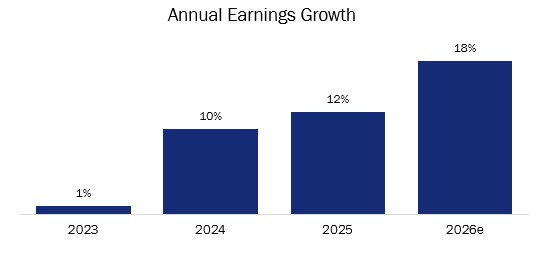
Despite the pressure on software companies, the overall outlook for corporate earnings remains strong, with expectations increasing in recent weeks. Earnings growth of approximately 18% is now anticipated for the broader market in calendar year 2026. This combination of robust earnings and lower equity prices has decreased price-to-earnings ratios to more reasonable levels. At the beginning of the year, the S&P 500 traded at 23 times forward 12-month earnings; currently, multiples are closer to 19 times.
Screenshot 2026-04-07 163123
Source: Haverford
Annual Earnings Growth
Source: Haverford
Market Rotation and Diversification
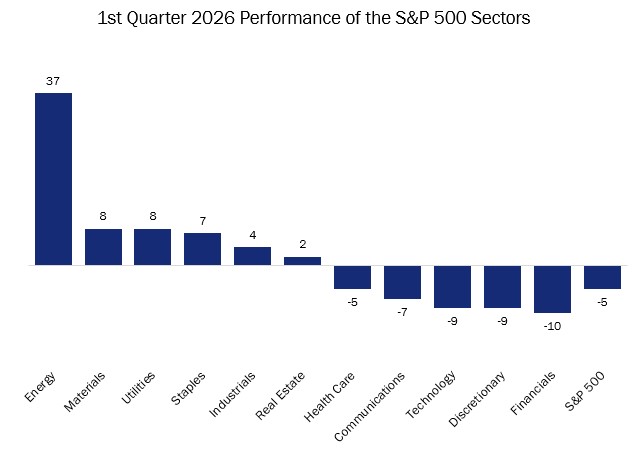
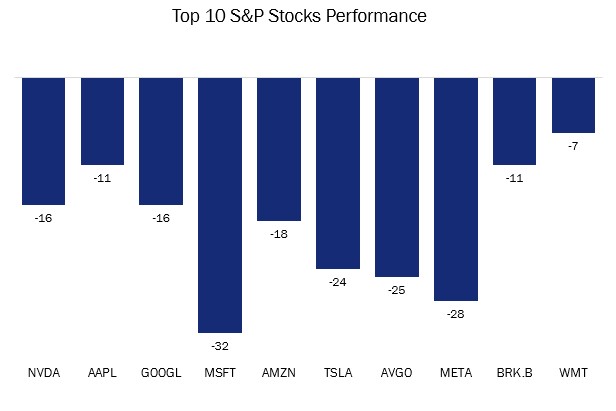
The first quarter experienced a notable market rotation: the largest technology and AI-related stocks have lagged while value-oriented and “old-economy” stocks outperformed. Diversified portfolios have benefited from this rotation and highlight the benefits of prudent risk management. Six of the ten largest S&P stocks are trading in bear market territory (down more than 20% from their highs) and of those ten only Walmart is down less than 10%.
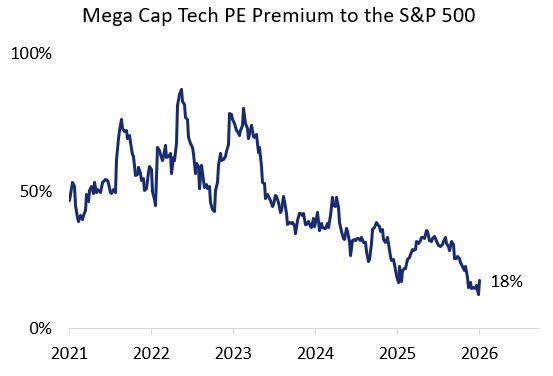
Mega-cap tech earnings expectations have remained strong. As a group, excluding Tesla, these stocks currently trade at approximately 22 times earnings. The gap between their valuation multiples and that of the broader market is now as tight as it has been over the last five years.
Screenshot 2026-04-07 164450
Source: Haverford
Screenshot 2026-04-07 165035
Source: Haverford
Screenshot 2026-04-07 162908
Source: Haverford
The TACO Effect
Since April 9th, 2025, the day Trump capitulated on his most draconian tariff proposals, markets have stayed alert to the “Trump Always Chickens Out” effect. This has led investors to expect more upside risk from Trump’s social media activity than downside risk and is one reason markets may have not sold off more during the first four weeks of the Iran war. The trading action during the last day of the first quarter is proof of this. The President’s ability to manipulate markets through social media posts may encourage greater risk-taking until events spiral out of control.
Recent events may have adjusted our overall outlook for the year, but they do not reverse it.
Significant fiscal and tax stimulus from the OBBBA will be flowing into the economy this year as tax returns are trending close to 15% higher than last year. As long as corporate profits materialize at or near expectations, we believe the U.S. domestic economy can weather higher oil prices for the next several months.
By that time investors alike will most likely be focused on the midterm elections. History suggests the President’s party typically loses control of the House in midterm elections, increasing the likelihood of a divided government, an outcome markets have often viewed favorably due to resulting policy restraint. While midterm election years have previously been among the most volatile of the four‑year cycle, data shows market drawdowns during these periods have typically been temporary and recovered in the months following the election. Despite the many factors that investors cannot control—geopolitics, headlines, and short‑term sentiment, history has consistently rewarded a focus on fundamentals, diversification, and long‑term optimism.
All charts as of 3/31/2026 unless otherwise noted.
Media Inquiries
Veronica McKee, CMP, CMM
Direct Phone: 610.995.8758
Email: vmckee@haverfordquality.com
Katie Karsh
Direct Phone: 610.755.8682
Email: katie@gobraithwaite.com
Disclosure
These comments are provided as a general market overview and should not be relied upon as a forecast, research or investment advice, and is not a recommendation, offer, or solicitation to buy or sell any securities or to adopt any investment strategy. Opinions expressed are as of the date noted and may change at any time. The information and opinions are derived from proprietary and non-proprietary sources deemed by Haverford to be reliable, but are not necessarily all-inclusive and are not guaranteed as to accuracy. Index returns are presented for informational purposes only. Indices are unmanaged, do not incur fees or expenses, and cannot be invested in directly.
Investments in Securities are Not FDIC Insured · Not Bank Guaranteed · May Lose Value
Related News & Insights
With just days until the U.S. midterm elections, it is nearly impossible to escape the political news cycle. However, election results historically have had less impact on market performance than political candidates would have one believe.
The U.S. equity bull market just turned four years old. One defining characteristic of this bull market, and of growing concern to many investors, is its lack of breadth. Historically, narrow market leadership has often been viewed as a warning sign, raising concerns that the market’s foundation may be weaker than headline index returns suggest.

Investors are navigating a market environment increasingly shaped by a sequence of interconnected forces. Geopolitical tensions are keeping energy prices high. Rising energy prices are contributing to persistent inflation pressures. Elevated inflation is keeping the Fed hawkish and contributing to higher Treasury yields. But despite these headwinds, the U.S. economy continues to demonstrate resilience.
