

Timothy A. Hoyle, CFA, Chief Investment Officer thoyle@haverfordquality.com
Pivotal Week for the Markets
The week of July 27th is likely to be the most pivotal week of the summer season with financial markets focused on several variables expected to set the tone until the mid-term elections. Thus far, second-quarter earnings season has delivered positive results, while interest rates are rising and hostilities in Iran have reignited. AI remains a transformative force, but this earnings season the market has become increasingly focused on whether the enormous capital investments being made today will ultimately generate adequate returns for shareholders.
Oil, Inflation, and Interest Rates Reemerge as Pressure Points
Markets spent much of the past year benefiting from moderating inflation and expectations that the Federal Reserve would eventually be in a position to ease monetary policy. Even the onset of the Iran war brought only a brief spike in prices, and a sense that peak inflation was behind us. However, the fragility of the ceasefire and rising energy prices over the past two weeks have reintroduced uncertainty.
As oil volatility has increased, Treasury yields have moved higher. The 10-year Treasury yield ended last week near 4.7% from its low point under 4% in February. Not only do higher oil prices and rising yields potentially delay future monetary easing, but they also put pressure on the consumer thus increasing the chance for political repercussions in November. For investors, these forces will increase borrowing costs and potentially create valuation headwinds for equities.
This week, Kevin Warsh’s second Federal Open Market Committee (FOMC) meeting will be scrutinized for any indication that rising energy prices and persistent inflation pressures are influencing the Fed’s outlook. Market expectations have shifted noticeably over the past week. According to the CME FedWatch Tool, there is a greater than 50% probability of a rate increase by year end.
When Will AI Spending Produce Results
While interest rates are likely to be the focus of many headlines this week, they will likely have a muted bearing on the market’s longer-term direction relative to the all-encompassing AI trade.
As the defining investment theme of the past two years, markets consistently rewarded companies who announced increased AI-related capital spending plans, viewing those expenditures as evidence of future competitive advantage. That dynamic has shifted in 2026 as the stocks of major hyperscalers have been under pressure while the beneficiaries of their spending have been rewarded.
Investors are increasingly demanding tangible evidence of return on investment rather than simply applauding larger spending commitments. The market’s reaction to Alphabet’s earnings release and increased CapEx guidance suggests that investors are becoming more skeptical of larger spending plans.
Consensus estimates now suggest that AI-related capital expenditures could approach $870 billion by year-end 2026, representing roughly 77% year-over-year growth. Funding AI infrastructure buildout increasingly requires substantial balance-sheet commitments. Across the five largest hyperscalers, aggregate debt issuance has expanded dramatically—from roughly $40-50 billion historically, much of which supported share repurchase programs, to nearly $200 billion in 2026 with the majority of proceeds helping fund data-center construction, computing infrastructure, and AI-related investments.
In our view, this evolution will ultimately prove to be a healthy transition if it promotes capital discipline and stronger returns on investment. However, it is likely to present even more volatility as investors attempt to discern how effectively these companies can convert spending into earnings growth and return to free cash flow generation.
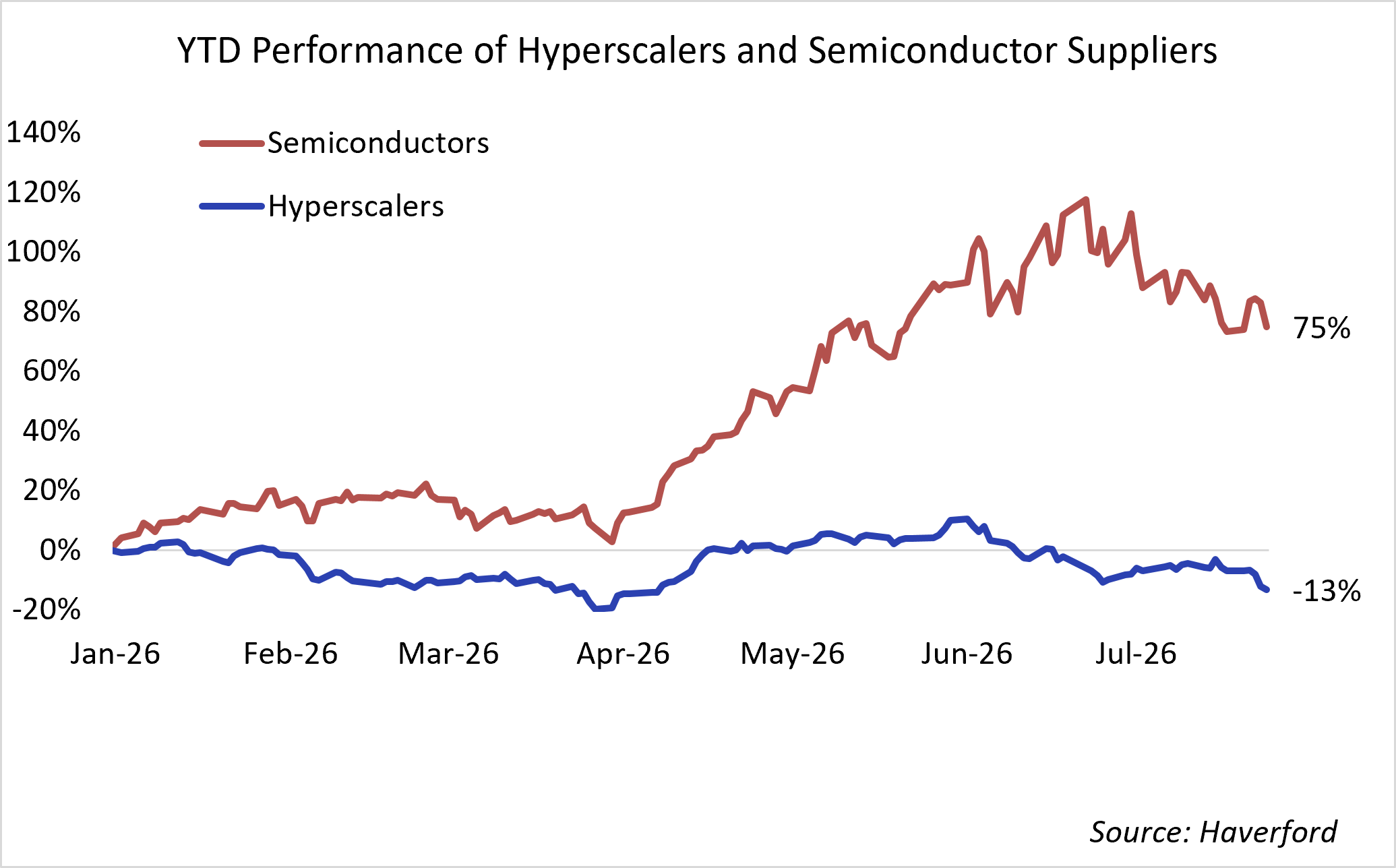
YTD Performance of Hyperscalers and Semiconductor Suppliers
Note: Semiconductors represented by SOXX ETF. Hyperscalers represent an equal weighted basket of 5 stocks: Microsoft, Amazon, Alphabet, Meta, and Oracle.
Periods like this often bring more questions than immediate answers, particularly when macro uncertainty intersects with a major long-term investment theme like AI. We would expect some volatility as markets digest the Fed’s messaging, energy price pressures, and the latest round of earnings. Even so, we believe a disciplined, long-term approach remains the best way to navigate near-term uncertainty while staying focused on durable opportunities.
Media Inquiries
Veronica McKee, CMP
Direct Phone: 610.995.8758
Email: vmckee@haverfordquality.com
Katie Karsh
Direct Phone: 610.755.8682
Email: katie@gobraithwaite.com
Disclosure
These comments are provided as a general market overview and should not be relied upon as a forecast, research or investment advice, and is not a recommendation, offer, or solicitation to buy or sell any securities or to adopt any investment strategy. Opinions expressed are as of the date noted and may change at any time. The information and opinions are derived from proprietary and non-proprietary sources deemed by Haverford to be reliable, but are not necessarily all-inclusive and are not guaranteed as to accuracy. Index returns are presented for informational purposes only. Indices are unmanaged, do not incur fees or expenses, and cannot be invested in directly.
Investments in Securities are Not FDIC Insured · Not Bank Guaranteed · May Lose Value
Related News & Insights
John F. Thomas, CFA Vice President, Fixed Income Portfolio Manager jthomas@haverfordquality.com Hut, Hut, Hike? [...]

While New Year’s resolutions are likely long forgotten, it is never too late to [...]

Timothy A. Hoyle, Chief Investment Officer thoyle@haverfordquality.com Last Week of August: A Consequential Week [...]
