

Timothy A. Hoyle, Chief Investment Officer
thoyle@haverfordquality.com
Last Week of August: A Consequential Week as Markets Absorb Big Signals
The last week of August is typically reserved for holiday vacations and back–to–school prep. However, this time around the last week of August demanded investors' attention. From a landmark legal settlement reshaping social media to a record-shattering earnings report that reaffirmed the AI investment super cycle, and a closely watched speech from the new Chair of the Federal Reserve, markets had no shortage of consequential news to process. Our key takeaway: the bull case, founded on capex–driven earnings growth, remains intact.
Meta: A Landmark Settlement
On August 26, Meta reached a sweeping legal settlement with 47 states, agreeing to pay up to $16.7 billion and implement significant child-safety remedies. While a large sum, the financial penalties paid over 10 years are very manageable. The settlement focuses on reforms to the way Facebook and Instagram interact with children, mandating a default two-hour daily time limit for teens, "Night Mode" blocking app access from midnight to 6 a.m., disabled likes for minors, and enhanced age-verification technology. Upon learning that these commonsense safeguards are expected to have a minimal effect on Meta's bottom line, parents would be rightly incensed the measures were not implemented sooner.
For investors, the settlement removes a major legal overhang for Meta. Florida remains the lone state to settle with Meta. We view the clarity on regulatory risk as ultimately positive for the stock. The mandated safety features, long sought by regulators, may also reduce the threat of future federal legislation. We are surprised the stock, up only a couple percent on the news, was not up more. This is a signal to us that Meta's extravagant capex plans remain investors' key concern. We are optimistic that computing power will be highly valuable in the future and Meta will be able to monetize current cap.
NVIDIA: The AI Trade Is Alive and Well
If there was any doubt about the durability of the AI investment thesis, NVIDIA's latest results should put it to rest for the time being. The company reported $96.2 billion in second quarter revenue, up 106% year over year, with data center sales surging 92% to $75.2 billion. Shares rose nearly 9% on the report, adding approximately $440 billion in market capitalization in a single day's trading.
CEO Jensen Huang declared that AI has "reached its inflection point," and noted that the number of enterprises requiring large graphics processing unit (GPU) clusters has expanded dramatically. CFO Colette Kress guided to 70% revenue growth for fiscal 2028, with CEO Huang clarifying that underlying demand is "much greater than 70%," and constrained only by supply. (Nvidia's fiscal year ends in January, meaning FY 2028 runs from February 2027 to January 2028.) Management's comments support the narrative that this capital spending super cycle is being driven by real enterprise adoption. NVIDIA remains at the center of the AI boom, but trades at only 15x next year's expected earnings. This signals investors are cautious that NVIDIA will be able to sustain and grow from current levels.
Top 10 S&P Stocks Performance
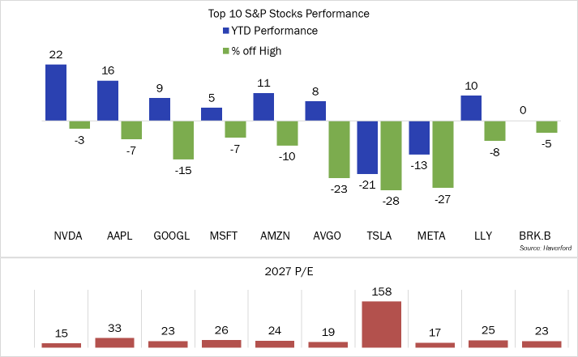
top 10 S&P
Source: Haverford, FactSet
Kevin Warsh Jackson Hole Speech
Federal Reserve (Fed) Chairman Warsh's first Jackson Hole address, while offering no forward guidance, contained several quote-worthy moments. Warsh articulated a governance philosophy centered on institutional credibility and a "quieter" Fed.
The chairman offered plenty to make the inflation hawks happy and assert Fed independence and institutional credibility. On inflation, Warsh stated, "While this summer's readings were better than expected, they do not tell me that underlying trends have meaningfully improved. We must be confident that underlying inflation is moving to our objective, clearly and at sufficient speed. Otherwise, we have work to do."
He also pushed back on market dependence on Fed guidance. He likened market reliance on Fed guidance to a "hall of mirrors," stating, "if markets rely materially on the Fed's guidance and the Fed relies on market prices, we are all more likely to be blinded to new developments."
Warsh spoke optimistically about artificial intelligence, noting that "we've come to a hinge point in history" and that AI is "potentially a new factor of production." Traditionally, economists have viewed labor, capital, and land as the three primary drivers of economic output. Warsh's point is that AI may become a fourth driver by significantly enhancing productivity across the economy. If that proves true, the economy could grow faster without generating the same inflationary pressures that traditionally accompany stronger growth, potentially requiring policymakers to rethink some long-held economic assumptions.
Last week's headlines were collectively bullish: the removal of a significant legal overhang at Meta, confirmation that AI-related capital spending remains robust, and a Fed speech that reset longer-term expectations without unsettling markets.
As we enter September, a month that has historically been challenging for equities, the fundamental driver of long-term stock prices, earnings growth, remains intact. While higher yields and an uncertain political landscape may contribute to near-term volatility, the combination of healthy corporate profits, continued investment in AI infrastructure, and improving productivity prospects supports a constructive long-term outlook.
Media Inquiries
Veronica McKee, CMP
Direct Phone: 610.995.8758
Email: vmckee@haverfordquality.com
Katie Karsh
Direct Phone: 610.755.8682
Email: katie@gobraithwaite.com
Disclosure
These comments are provided as a general market overview and should not be relied upon as a forecast, research or investment advice, and is not a recommendation, offer, or solicitation to buy or sell any securities or to adopt any investment strategy. Opinions expressed are as of the date noted and may change at any time. The information and opinions are derived from proprietary and non-proprietary sources deemed by Haverford to be reliable, but are not necessarily all-inclusive and are not guaranteed as to accuracy. Index returns are presented for informational purposes only. Indices are unmanaged, do not incur fees or expenses, and cannot be invested in directly.
Investments in Securities are Not FDIC Insured · Not Bank Guaranteed · May Lose Value
Related News & Insights
Timothy A. Hoyle, Chief Investment Officer thoyle@haverfordquality.com A Market out of Breadth On October [...]

During the third quarter of 2025, the S&P 500 rose nearly 8%, recorded 24 all-time high closes, and was never down more than 2%. Heading into the final quarter of the year we anticipate three major trends from the third quarter will continue to power the market’s steady ascension.

Jason Salmon, CFP®, CSS, Wealth Planner jsalmon@haverfordquality.com 5 Things to Consider for Medicare Open [...]
