

Timothy A. Hoyle, Chief Investment Officer
thoyle@haverfordquality.com
A Market out of Breadth
On October 12, 2026, the U.S. equity bull market turned 4 years old. The S&P 500 has returned 118% since the lows of 2022. One of the defining characteristics of this bull market, and of growing concern to many investors, is its lack of breadth, with some experts comparing it to the dot-com bubble era of late 1999 and early 2000. Recent market performance underscores this dynamic as the equal-weight S&P 500 is up 66% over the same 4 years. Today’s S&P 500 has continued to advance, but a relatively small group of technology companies has accounted for a disproportionate share of the gains. Meanwhile, many sectors have generated only modest returns. Historically, narrow market leadership has often been viewed as a warning sign, raising concerns that the market’s foundation may be weaker than headline index returns suggest.
There is certainly some truth to those concerns. Only about 30% of S&P 500 Index constituents are outperforming the index on a three-year trailing basis, according to J.P. Morgan research.
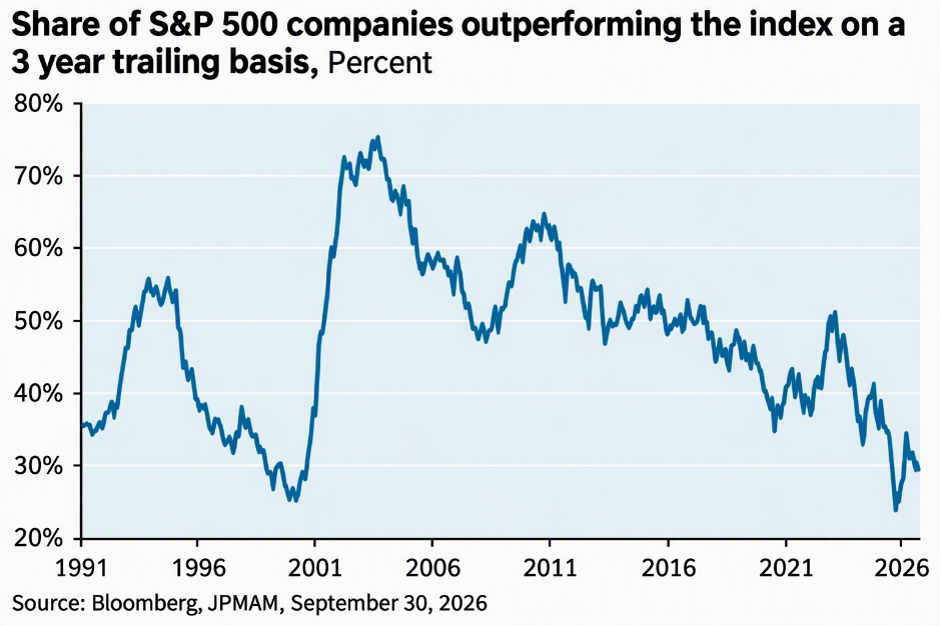
Share of S&P Outperforming 3yr Trailing Basis
Sources: Michael Cembalest, J.P. Morgan Asset Management
In terms of market capitalization, concentration has reached historically elevated levels. The top five largest technology and artificial intelligence (AI)-related companies currently equal the total market capitalization of the bottom 434 companies in the S&P 500. Such concentration naturally increases the market’s sensitivity to developments affecting a small number of companies, increasing potential risk and volatility.
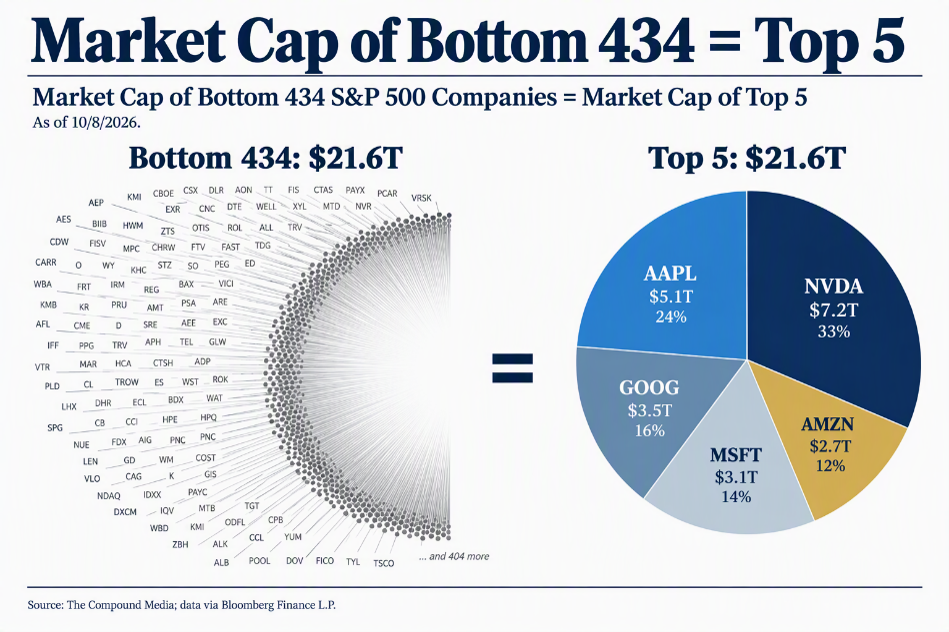
Market Cap of Bottom 434
Source: The Compound News
Outsized Earnings Growth behind Narrow Market
However, we believe it is important to understand why breadth has narrowed before concluding that the market is exhibiting classic late-cycle behavior. In past speculative periods, narrow leadership was often driven by investor enthusiasm detached from underlying fundamentals. Today’s environment appears meaningfully different.
The companies driving market returns are also generating an outsized share of earnings growth. Massive investments in AI infrastructure, cloud computing, semiconductor capacity, networking equipment, and data center construction have created an unusually concentrated set of economic winners. As a result, earnings growth, earnings revisions, cash flow generation, and capex have become concentrated in the same companies that have driven stock market performance.
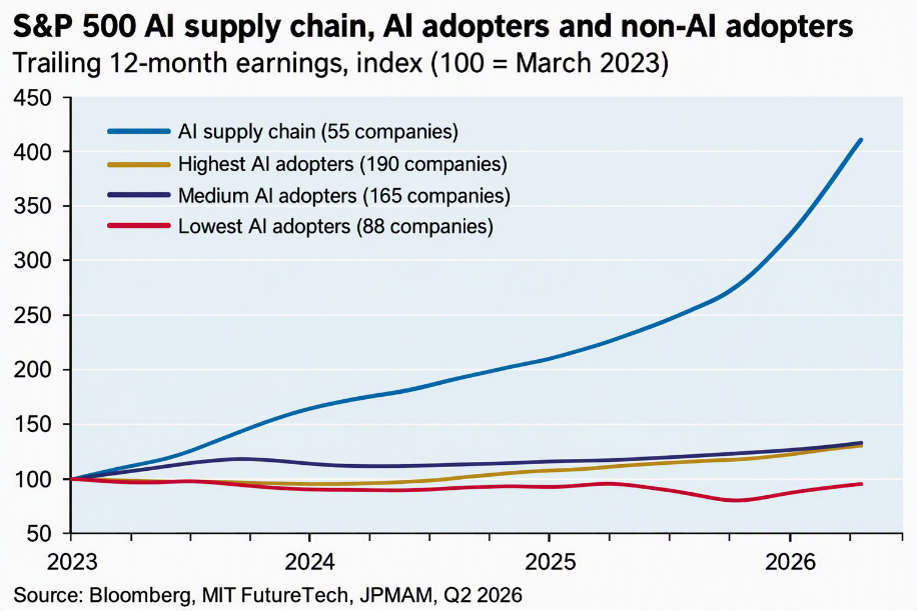
S&P AI Supply Chain Earnings
Sources: J.P. Morgan Asset Management, Bloomberg, MIT FutureTech
Stated differently, the market is not simply rewarding momentum or a handful of popular stocks. It is rewarding a relatively small group of companies producing a disproportionate share of corporate profit growth. This distinction matters. Strong earnings growth has historically been one of the most reliable drivers of long-term stock returns. While valuation and sentiment fluctuate over shorter periods, earnings typically determine value creation. The market’s narrow leadership therefore appears tied less to speculation and more to the reality that the benefits of the AI investment cycle have not yet spread evenly across the broader economy.
S&P 500 Expected Earnings Growth
As of September 30, 2026
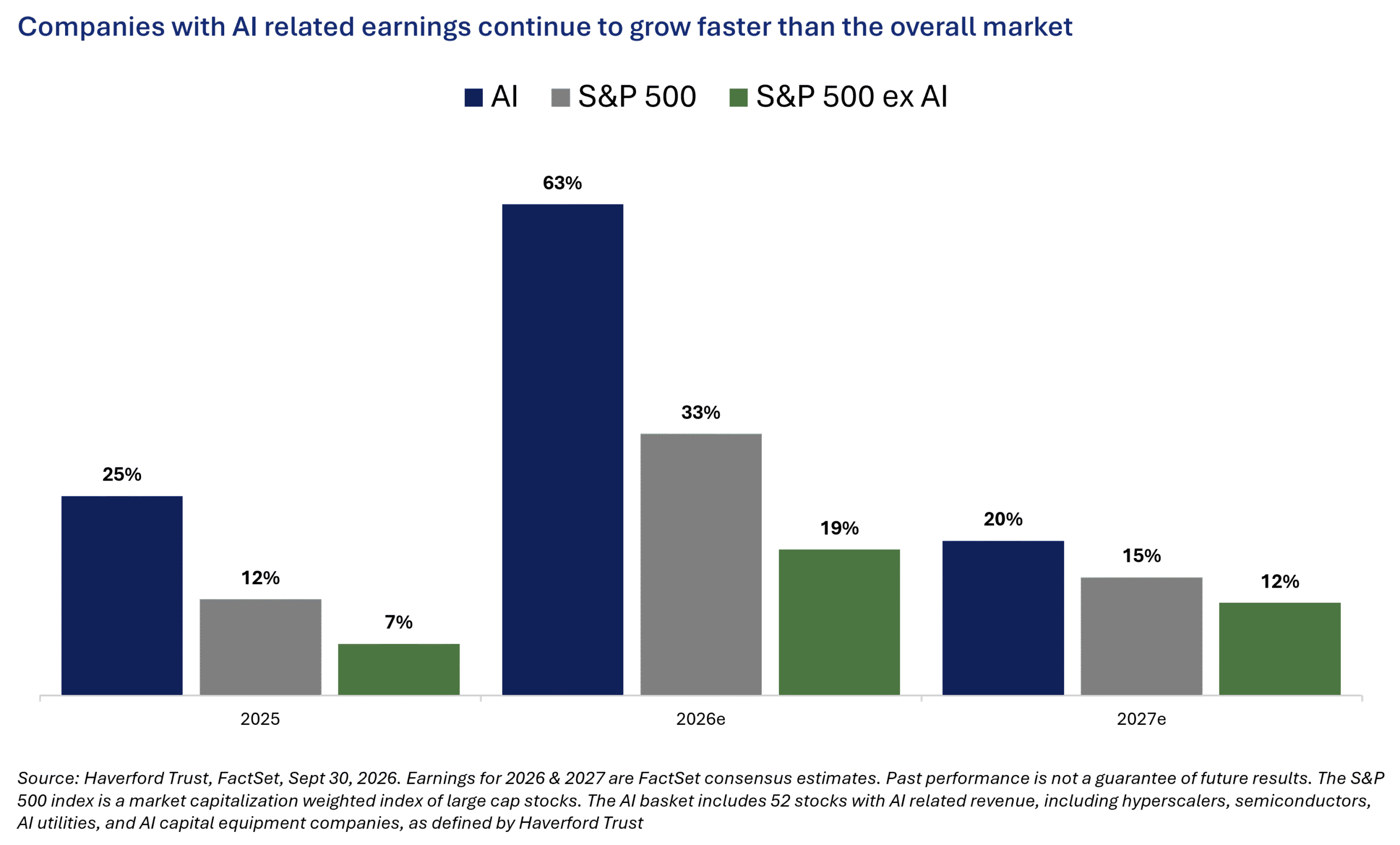
SP500 Expected Earnings Growth
Sources: FactSet, Haverford
Challenging Environment for Managing Risk
This environment has also created a challenging backdrop for actively managed portfolios focused on diversification, valuation discipline, and risk management. When a small group of stocks is responsible for an outsized share of market gains, portfolios that seek to limit concentration risk often struggle to keep pace with capitalization-weighted benchmarks. This phenomenon has been particularly evident in 2026 as AI-related winners have increasingly dominated index returns while many high-quality businesses with solid fundamentals have generated more modest performance.
That does not mean investors should ignore concentration. Elevated concentration often increases risk. If earnings growth among AI leaders were to disappoint, the impact on major market indices could be significant. Likewise, persistent investor enthusiasm has created lofty expectations that may prove difficult to exceed. A market dependent on a small number of companies has less margin for error than one supported by broad participation.
Reasons for Optimism
At the same time, we see reasons for optimism. In our view, the key question is not whether market breadth is narrow today. That observation is undeniable given the present market environment and the small number of companies driving the S&P 500’s gains. The more important question is whether the earnings advantages currently enjoyed by AI leaders eventually spread to a wider group of companies. If that occurs, breadth could improve through stronger participation rather than through weakness in current market leaders.
Many sectors outside of technology continue to generate healthy profits and trade at considerably more reasonable valuations. Financials, healthcare, industrials, materials, and select consumer businesses are producing solid results despite receiving far less investor attention. Over time, we expect market leadership to broaden as economic benefits from AI diffuse through supply chains, customers, and complementary industries.
For long-term investors, we believe diversification and discipline are important. While breadth remains a risk worth monitoring, the underlying fundamentals supporting many of today’s leaders differentiate this period from past episodes of market excess. We expect earnings growth to broaden over time as the AI cycle encompasses a wider opportunity set, and investors who have maintained exposure to a diversified group of quality businesses may ultimately benefit.
Media Inquiries
Veronica McKee, CMP
Direct Phone: 610.995.8758
Email: vmckee@haverfordquality.com
Katie Karsh
Direct Phone: 610.755.8682
Email: katie@gobraithwaite.com
Disclosure
These comments are provided as a general market overview and should not be relied upon as a forecast, research or investment advice, and is not a recommendation, offer, or solicitation to buy or sell any securities or to adopt any investment strategy. Opinions expressed are as of the date noted and may change at any time. The information and opinions are derived from proprietary and non-proprietary sources deemed by Haverford to be reliable, but are not necessarily all-inclusive and are not guaranteed as to accuracy. Index returns are presented for informational purposes only. Indices are unmanaged, do not incur fees or expenses, and cannot be invested in directly.
Investments in Securities are Not FDIC Insured · Not Bank Guaranteed · May Lose Value
Related News & Insights

Timothy A. Hoyle, Chief Investment Officer thoyle@haverfordquality.com A Market out of Breadth On October [...]

During the third quarter of 2025, the S&P 500 rose nearly 8%, recorded 24 all-time high closes, and was never down more than 2%. Heading into the final quarter of the year we anticipate three major trends from the third quarter will continue to power the market’s steady ascension.

Jason Salmon, CFP®, CSS, Wealth Planner jsalmon@haverfordquality.com 5 Things to Consider for Medicare Open [...]
