

Timothy A. Hoyle, CFA, Chief Investment Officer
thoyle@haverfordquality.com
Markets End May on a High. All Eyes on the SpaceX IPO
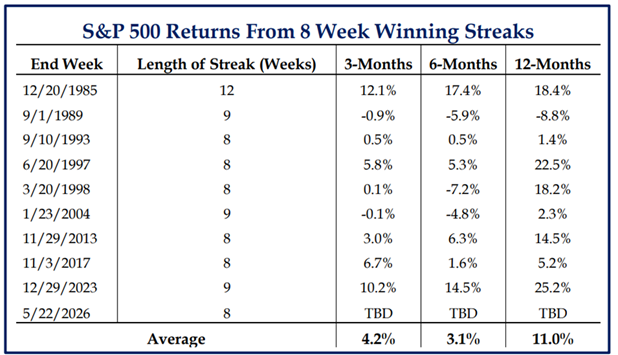
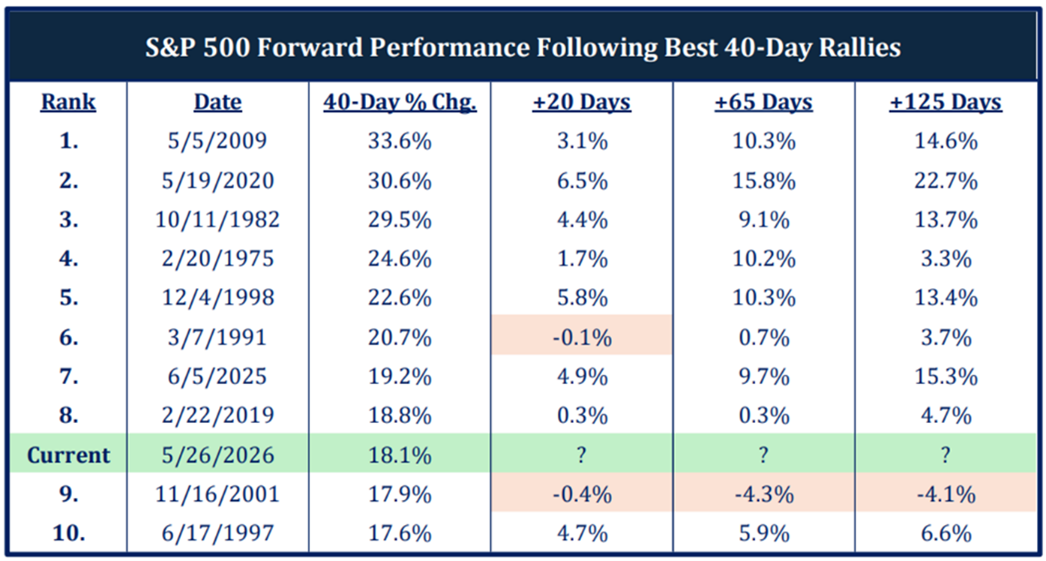
The Dow, S&P 500, and Nasdaq all closed May at record highs. The S&P 500 has risen for nine consecutive weeks of positive returns and one of the strongest 40-day rallies in history. May 27th marked the 40th trading day since the Iran war–induced sell-off. Over that span, the market has rallied nearly 20% without a single weekly decline.
This has occurred despite rising inflation and higher yields, supported by powerful earnings growth tied to the ongoing data center buildout. While such a rapid rise may invite skepticism from a prudent investor, market history suggests more gains may lie ahead. Similarly, in nine of the ten strongest 40-day rallies on record, markets were higher six months later.
Picture1
Source: Strategas
Picture2
Source: Strategas
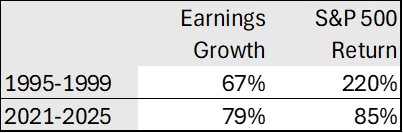
We are often asked whether today’s backdrop resembles 1999 and the subsequent dot-com crash, and while there are some parallels, there are also stark and notable differences. In the late 1990s, equity gains far outpaced earnings growth. Today, earnings have largely kept pace with market appreciation. Earnings are expected to grow 24% in 2026, resulting in a contraction of forward price to earnings multiples even as stock prices rise.
Source: Strategas and Bloomberg
Corporate profitability underpins another major difference between now and 1999. Today’s CapEx boom is being funded predominantly by the cash flows of the largest technology companies, in contrast to the externally financed infrastructure expansion of the ‘90s. There also appears to be more immediate and tangible demand underpinning today’s data center investments. We see no corollary to the “dark fiber” of the past cycle when telecom companies massively overbuilt network capacity ahead of demand, leaving large amounts of unused infrastructure.
We also have yet to experience the unbounded excitement for initial public offerings (IPOs) that existed a generation ago. The planned IPOs of SpaceX, Open AI, and Anthropic could meaningfully absorb market liquidity and create “forced sellers” of other large-cap tech stocks, as investors reposition portfolios to make room for these juggernauts. Granted, only SpaceX has officially filed to IPO as soon as June 12, but we expect the leading AI labs to follow closely behind.
The SpaceX (SPCX) IPO is anticipated to be the largest in history. The company expects to raise $75-80 billion by selling only 4-5% of its outstanding shares, implying an IPO value near $1.75 trillion[1]. The recent IPO of chipmaker Cerebras provides an example of investors’ current appetite. That offering was reportedly oversubscribed by 20 times and the stock opened nearly 90% above the IPO price. Cerebras benefited from none of the Musk halo or retail hype. Based on the demand for SPCX shares from retail and institutional investors, there is a reasonable path toward a $3 trillion market capitalization shortly after trading begins.
[1] data mapping out the size and value of SpaceX include: We Put SpaceX’s Pending Massive IPO in Perspective – WSJ . 6 Charts on SpaceX’s Pre-IPO Financials | Morningstar. 5 Charts That Make Sense of SpaceX’s IPO Numbers — The Information
Media Inquiries
Veronica McKee, CMP, CMM
Direct Phone: 610.995.8758
Email: vmckee@haverfordquality.com
Katie Karsh
Direct Phone: 610.755.8682
Email: katie@gobraithwaite.com
Disclosure
These comments are provided as a general market overview and should not be relied upon as a forecast, research or investment advice, and is not a recommendation, offer, or solicitation to buy or sell any securities or to adopt any investment strategy. Opinions expressed are as of the date noted and may change at any time. The information and opinions are derived from proprietary and non-proprietary sources deemed by Haverford to be reliable, but are not necessarily all-inclusive and are not guaranteed as to accuracy. Index returns are presented for informational purposes only. Indices are unmanaged, do not incur fees or expenses, and cannot be invested in directly.
Investments in Securities are Not FDIC Insured · Not Bank Guaranteed · May Lose Value
Related News & Insights
With just days until the U.S. midterm elections, it is nearly impossible to escape the political news cycle. However, election results historically have had less impact on market performance than political candidates would have one believe.

The U.S. equity bull market just turned four years old. One defining characteristic of this bull market, and of growing concern to many investors, is its lack of breadth. Historically, narrow market leadership has often been viewed as a warning sign, raising concerns that the market’s foundation may be weaker than headline index returns suggest.

Investors are navigating a market environment increasingly shaped by a sequence of interconnected forces. Geopolitical tensions are keeping energy prices high. Rising energy prices are contributing to persistent inflation pressures. Elevated inflation is keeping the Fed hawkish and contributing to higher Treasury yields. But despite these headwinds, the U.S. economy continues to demonstrate resilience.
