

Tim Hoyle, Chief Investment Officer
Thoyle@haverfordquality.com
Geopolitical Shock, Market Resilience
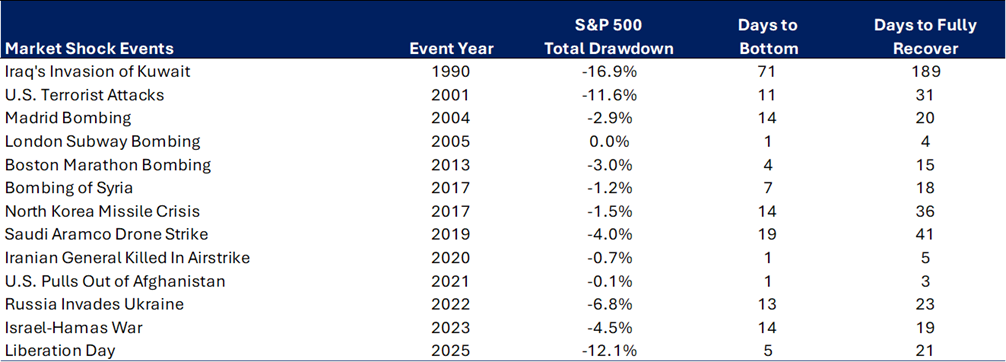
Geopolitical events have historically created short‑term volatility but rarely result in lasting damage to equity markets. This historical framework should provide investors comfort in holding equities through the current conflict. However, the war with Iran does present greater risks than prior Middle East flare‑ups, largely because of the unprecedented closure of the Strait of Hormuz and direct, sustained attacks on critical energy and industrial infrastructure across the Gulf region.
The Strait of Hormuz is one of the world’s most important economic chokepoints, normally conveying roughly 20% of global oil and liquified natural gas (LNG) trade. Shipping through the Strait has fallen to a “trickle” since early March as Iranian forces declared the passage closed and successfully attacked and sunk several commercial vessels. The International Energy Agency (IEA) has characterized the disruption as the largest oil supply shock in history, exceeding in magnitude even the 1970s embargo in percentage terms. IEA member nations have responded with a coordinated release of emergency oil reserves.
This conflict is also distinct in that Iranian drone and missile strikes have targeted energy facilities, storage hubs, desalination plants, and transportation infrastructure across multiple Gulf States. These actions extend the risk beyond shipping lanes and onto the physical ability to produce, store, and move commodities, reinforcing concerns that disruptions could last longer than past geopolitical shocks. As a result, oil prices briefly moved above $100 per barrel and remain highly volatile, with insurance costs and shipping availability now playing as critical a role as physical supply.
Stocks Usually Take Geopolitical Events in Stride
Picture1
Source: LPL Research, S&P, CFRA, Haverford Trust, 3/2/2026. Past performance is no guarantee of future results.
We entered 2026 aware it could be a challenging year for equities given the political cycle and elevated starting valuations. The current conflict increases the probability of a market correction (i.e., a decline of 10% or more) in coming months. That said, we foresee a low probability that a correction would morph into a prolonged bear market, where stocks decline at least 20%. Our thinking here is based upon the facts that corporate fundamentals and profits remain healthy, and the U.S. labor market, while increasingly fragile, has not deteriorated enough to cause immediate concern. The “no‑hire, no‑fire” job market is exhibiting stability of both unemployment claims and prime-age employment participation rate.
Historically dating back to 1942, market corrections during mid-term election years have been followed by positive equity returns over the subsequent 12 months, even when volatility rises during the election cycle itself.
Haverford’s portfolios are built to be “all‑weather”, emphasizing investments that can withstand unforeseen challenges while still participating in long‑term growth. Volatility rose in early 2025 around tariff concerns and technology‑driven disruptions, yet Corporate America adapted and delivered approximately 15% earnings growth for the year. While we did not anticipate a war, a sharp spike in oil prices, or emerging stress in private credit entering 2026, we continue to have confidence in the resilience of our high‑quality focused portfolios.
Periods of elevated uncertainty are uncomfortable, but they are also when portfolio construction and quality matter most. We position our clients to own a diversified group of asset classes, funds, and individual companies across geographies, sectors and industries. These portfolios are designed to withstand prolonged uncertainty, if for example, should the conflict continue and the Strait of Hormuz remain closed. Individual stock holdings such as Chevron, Honeywell, Linde, Air Products, Costco, Pepsi, RTX, McDonald’s, and Waste Management did not participate in the speculative AI enthusiasm of recent years, but they have demonstrated relative strength amid recent volatility. Each has passed our quality screens, characterized by low leverage, strong free‑cash‑flow generation, peer‑leading profitability, and consistent dividend growth.
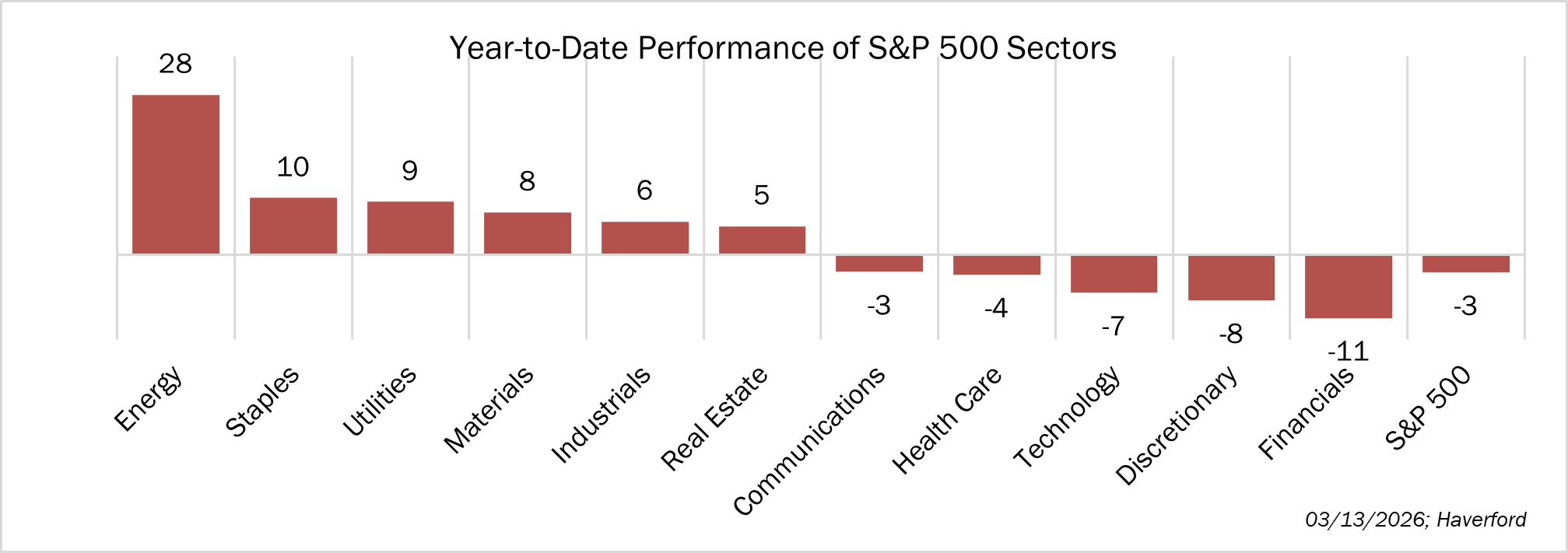
Some sectors of the market, such as Energy and Materials, are directly benefiting from supply disruptions. However, investments in Industrials and Consumer Staples have also served portfolios well. Industrials are benefiting from infrastructure spending and expectations for increased defense outlays, while many Consumer holdings have proven resilient in periods of slower growth and higher input costs. Utilities continue to provide a blend of defensiveness and secular growth tied to rising power demand.
Technology has been the largest drag on performance year‑to‑date, particularly software and consulting companies such as Microsoft, Intuit, Salesforce, and Accenture, which have declined sharply amid concerns about AI‑driven disruption. We will use volatility to rebalance portfolio positioning, ensuring appropriate exposure to both the beaten-down software industry and semiconductor stocks, which have become the picks and shovels of the AI infrastructure boom. Importantly, we believe our software positions have retained strong balance sheets, generate healthy free cash flow, and benefit from structural advantages such as proprietary data, regulatory entrenchment, or “system of record” status.
Financials, after a strong showing following President Trump’s election victory, have recently detracted from performance. Initially, weakness stemmed from the public discussion of a proposed 10% credit‑card interest‑rate cap, which we view as a low probability based on industry analysis, but nonetheless emblematic of populist policy risk heading into the midterm election cycle. Pressure increased with concerns around private credit, particularly impacting asset managers such as BlackRock. We believe this reaction is overdone, as private credit represents a modest share of BlackRock’s overall assets and revenue. More broadly, we expect Financials to benefit from easing capital requirements, rising M&A activity, and improved capital‑markets conditions as volatility persists.
Picture2
Putting all this together, as of Friday March 13th, the S&P 500 has declined almost 5% from its all-time high close of 6978 on January 27th. It is worth noting that international equities continue to outperform year-to-date, as do small and mid-cap stocks in the U.S., building on strong gains from 2025. Developed markets are up about 1%, emerging markets +4.0%, and SMID +1.6%, all ahead of the S&P 500. This reflects both valuation dispersion and differing exposure to U.S.‑centric policy and technology risks.
Recent events may adjust our overall outlook for the year, but they do not reverse it. Significant fiscal and tax stimulus from the One Big Beautiful Bill Act is flowing into the economy this year. The results of the retroactive provisions of the OBBBA are driving materially larger tax refunds for households and renewed incentives for corporate investment, including full expensing for domestic research & development, manufacturing facilities, and capital equipment—all supportive of construction and business spending in 2026. At the same time, corporate fundamentals remain strong; consensus estimates call for double-digit earnings growth in 2026, well above long-term averages, supported by healthy margins and continued revenue growth across most sectors. Productivity gains driven by technology adoption and efficiency improvements are expected to support above-trend GDP growth, allowing the economy to expand without a commensurate rise in inflation, even as hiring remains subdued.
From a political standpoint, history suggests the President’s party typically loses control of the House in midterm elections, increasing the likelihood of a divided government, an outcome markets have often viewed favorably due to policy restraint. While midterm election years are among the most volatile of the four‑year cycle, historical data show that market drawdowns during these periods have typically been temporary and been recovered in the months following the election. There is much investors cannot control—geopolitics, headlines, and short‑term sentiment—but history has consistently rewarded a focus on fundamentals, diversification, and long‑term optimism.
Media Inquiries
Veronica McKee, CMP
Direct Phone: 610.995.8758
Email: vmckee@haverfordquality.com
Katie Karsh
Direct Phone: 610.755.8682
Email: katie@gobraithwaite.com
Disclosure
These comments are provided as a general market overview and should not be relied upon as a forecast, research or investment advice, and is not a recommendation, offer, or solicitation to buy or sell any securities or to adopt any investment strategy. Opinions expressed are as of the date noted and may change at any time. The information and opinions are derived from proprietary and non-proprietary sources deemed by Haverford to be reliable, but are not necessarily all-inclusive and are not guaranteed as to accuracy. Index returns are presented for informational purposes only. Indices are unmanaged, do not incur fees or expenses, and cannot be invested in directly.
Investments in Securities are Not FDIC Insured · Not Bank Guaranteed · May Lose Value
Related News & Insights

During the third quarter of 2025, the S&P 500 rose nearly 8%, recorded 24 all-time high closes, and was never down more than 2%. Heading into the final quarter of the year we anticipate three major trends from the third quarter will continue to power the market’s steady ascension.

Jason Salmon, CFP®, CSS, Wealth Planner jsalmon@haverfordquality.com 5 Things to Consider for Medicare Open [...]

Timothy A. Hoyle, Chief Investment Officer thoyle@haverfordquality.com The Fed's Credibility Test The Federal Reserve's [...]
