

Tim Hoyle, Chief Investment Officer
Thoyle@haverfordquality.com
AI, Speculation, and Market Fundamentals
As of mid-November, market exuberance has tempered. The cryptocurrency Bitcoin, which in many ways defines market speculation, is down close to 30% from its highs. As is AI hyperscaler Oracle and Facebook's parent Meta. There is a difference in how investors approach large declines across differing assets. When commodities such as Bitcoin fall – and rise – our only point of reference is their price. There are no underlying assets, cash flow, or earnings growth. That is the definition of a speculative asset. While there may be room for speculation in some portfolios, at Haverford we choose to focus on investments in companies with strong cash flows, the potential for consistent earnings generation, and solid business plans.
When the stocks of corporate blue chips fall, we know the underlying fundamentals will eventually be realized, and stocks, in the long run, gravitate towards their intrinsic value. Even if a stock price outruns corporate fundamentals in the near-term, as long as investors don't wildly overpay, fundamental growth leading to increased intrinsic value should eventually bail-out ill-timed stock purchases.
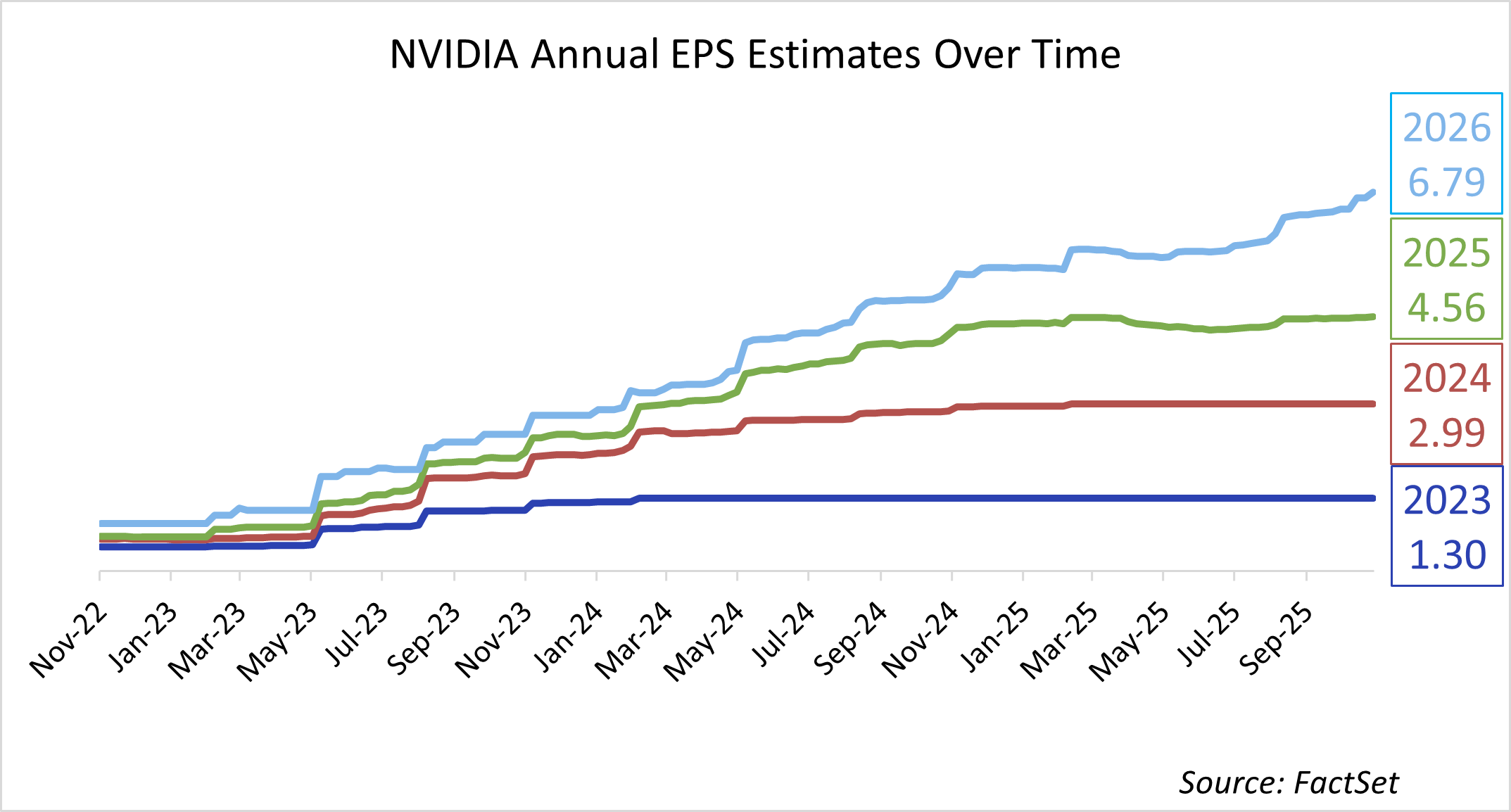
This week, investors will get financial results from the world's most valuable company. Nvidia's tremendous lifetime growth has not abated as the stock matured into a well-respected blue chip. NVIDIA, which posted 2023 earnings per share (EPS) of $1.30 is expected to report $4.56 in per-share profits this year, fueled by unprecedented demand to power AI data centers and cloud infrastructure. This is not speculative growth; it reflects real-world deployment of AI across enterprise and consumer applications.
Despite its meteoric rise and a market cap exceeding $4.5 trillion, NVIDIA is cheaper on a forward earnings basis than it was two years ago, thanks to earnings growth outpacing price appreciation. Its forward P/E ratio, while elevated, reflects robust profitability and a dominant position in AI infrastructure.
Picture1
Source: FactSet
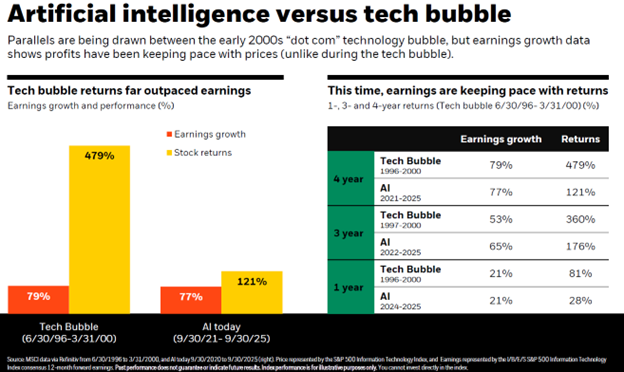
While critics of this tech-driven market draw parallels to the dot-com bubble of the late 1990s, the comparison misses a critical point: most of today's leaders are profitable, cash-rich, and investing from a position of strength. During the dot-com era, many companies were unprofitable and trading at astronomical multiples on the promise of future growth. Today, the S&P 500 Information Technology Index trades near 30× forward earnings, well below the ~55× multiple seen at the peak of the dot-com bubble.
A recent Blackrock Insights¹ article argues that while AI-related stocks have surged, the current environment differs from the dot-com bubble because earnings growth and real-world adoption of AI are accelerating. It highlights that valuations are elevated but supported by strong fundamentals, unlike the speculative nature of the tech bubble in the early 2000s. We concur with Blackrock's conclusion: investors should remain selective, focusing on companies with sustainable AI-driven revenue rather than chasing hype.
Picture2
Source: Blackrock
Prudence dictates that market prices are extended. However, there is a lack of evidence to show that prices are wildly unaligned with fundamentals. The market's October highs could be a near-term top, and after years of incredible gains investors should expect, and be prepared for, the inevitability of a rough patch to come.
At Haverford, we espouse disciplined investing with an eye to strong fundamentals and sustainable growth. We believe investors who bought stocks at recent highs (in some cases much higher highs) may need to exhibit some patience but may see their investments turn profitable as corporate intrinsic values grow.
Media Inquiries
Veronica McKee, CMP, CMM
Direct Phone: 610.995.8758
Email: vmckee@haverfordquality.com
Katie Karsh
Direct Phone: 610.755.8682
Email: katie@gobraithwaite.com
Disclosure
These comments are provided as a general market overview and should not be relied upon as a forecast, research or investment advice, and is not a recommendation, offer, or solicitation to buy or sell any securities or to adopt any investment strategy. Opinions expressed are as of the date noted and may change at any time. The information and opinions are derived from proprietary and non-proprietary sources deemed by Haverford to be reliable, but are not necessarily all-inclusive and are not guaranteed as to accuracy. Index returns are presented for informational purposes only. Indices are unmanaged, do not incur fees or expenses, and cannot be invested in directly.
Investments in Securities are Not FDIC Insured · Not Bank Guaranteed · May Lose Value
Related News & Insights

With just days until the U.S. midterm elections, it is nearly impossible to escape the political news cycle. However, election results historically have had less impact on market performance than political candidates would have one believe.

The U.S. equity bull market just turned four years old. One defining characteristic of this bull market, and of growing concern to many investors, is its lack of breadth. Historically, narrow market leadership has often been viewed as a warning sign, raising concerns that the market’s foundation may be weaker than headline index returns suggest.

Investors are navigating a market environment increasingly shaped by a sequence of interconnected forces. Geopolitical tensions are keeping energy prices high. Rising energy prices are contributing to persistent inflation pressures. Elevated inflation is keeping the Fed hawkish and contributing to higher Treasury yields. But despite these headwinds, the U.S. economy continues to demonstrate resilience.
