

Tim Hoyle, Chief Investment Officer
thoyle@haverfordquality.com
AI: Bubble and Opportunity
The S&P 500 hit an all-time high six days into a government shutdown. It seems nothing will slow this market down as long as three critical ingredients are in place: 1) easing monetary policy, 2) strong earnings growth, and 3) AI optimism. At least for now, weaker employment data, geo-politics, and weak consumer sentiment just doesn't matter.
The meteoric growth of AI-related investments leaves us all wondering if the bubble is about to burst, or if there is even a bubble at all. There is evidence to support both sides of the argument. It is very possible that a speculative fervor (a.k.a. bubble) exists while at the same time the AI theme can still offer strong returns for investors with a long-term horizon. Both can be true. Two recent Barron's headlines tell the story: a September 30 article was titled "Fears About an AI Bubble Are Fading. That's an Opportunity," while just six days later an article carried the headline, "How Much Longer Can the AI Bubble Last? Inside Wall Street's Great Debate."
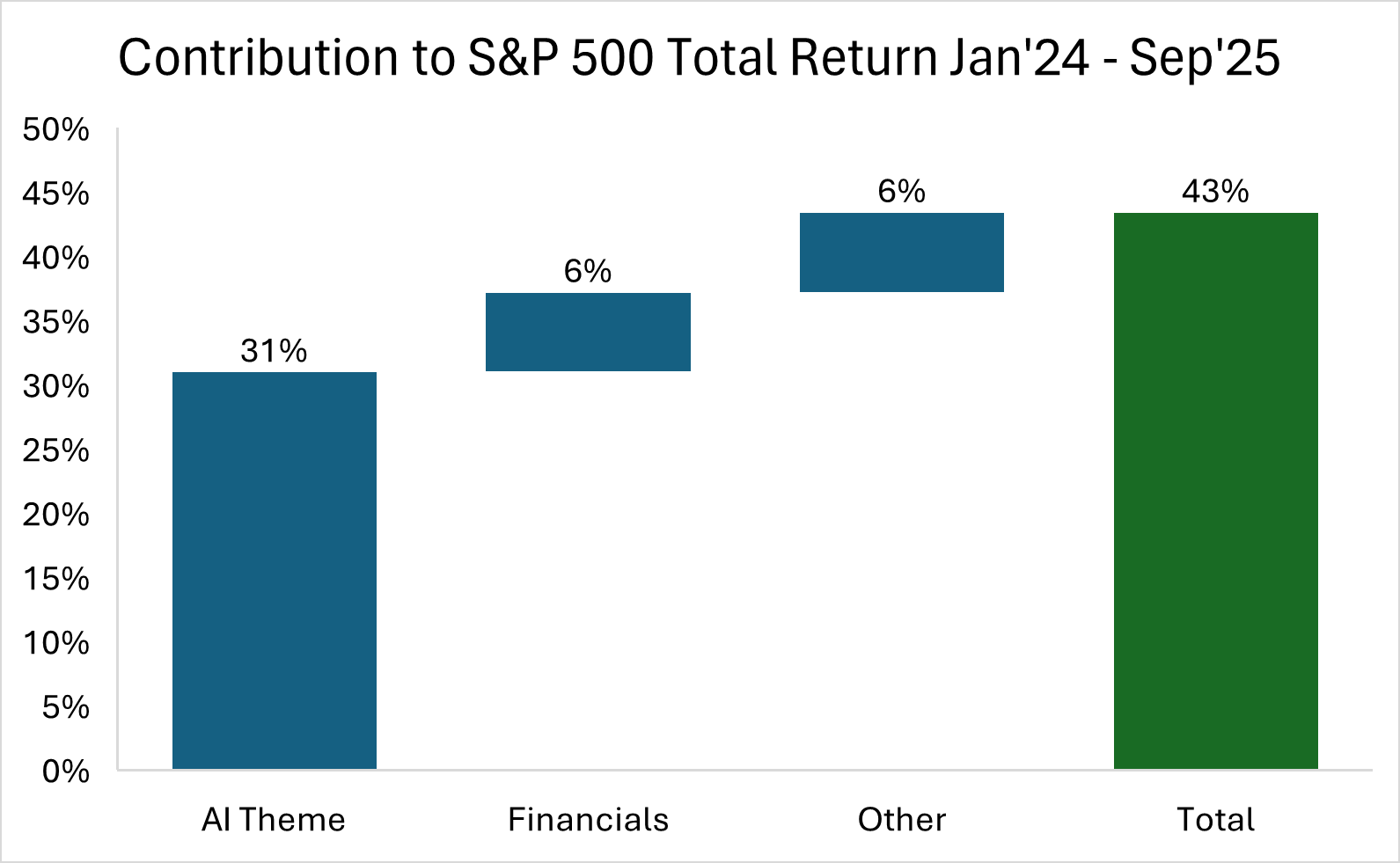
From the beginning of 2024 through September 2025, the S&P 500 is up 43%. Approximately 72% of the market's return is attributable to the AI theme, with the remaining performance being split between the re-rating in financial stocks and all other stocks.
Picture1
Source: Haverford
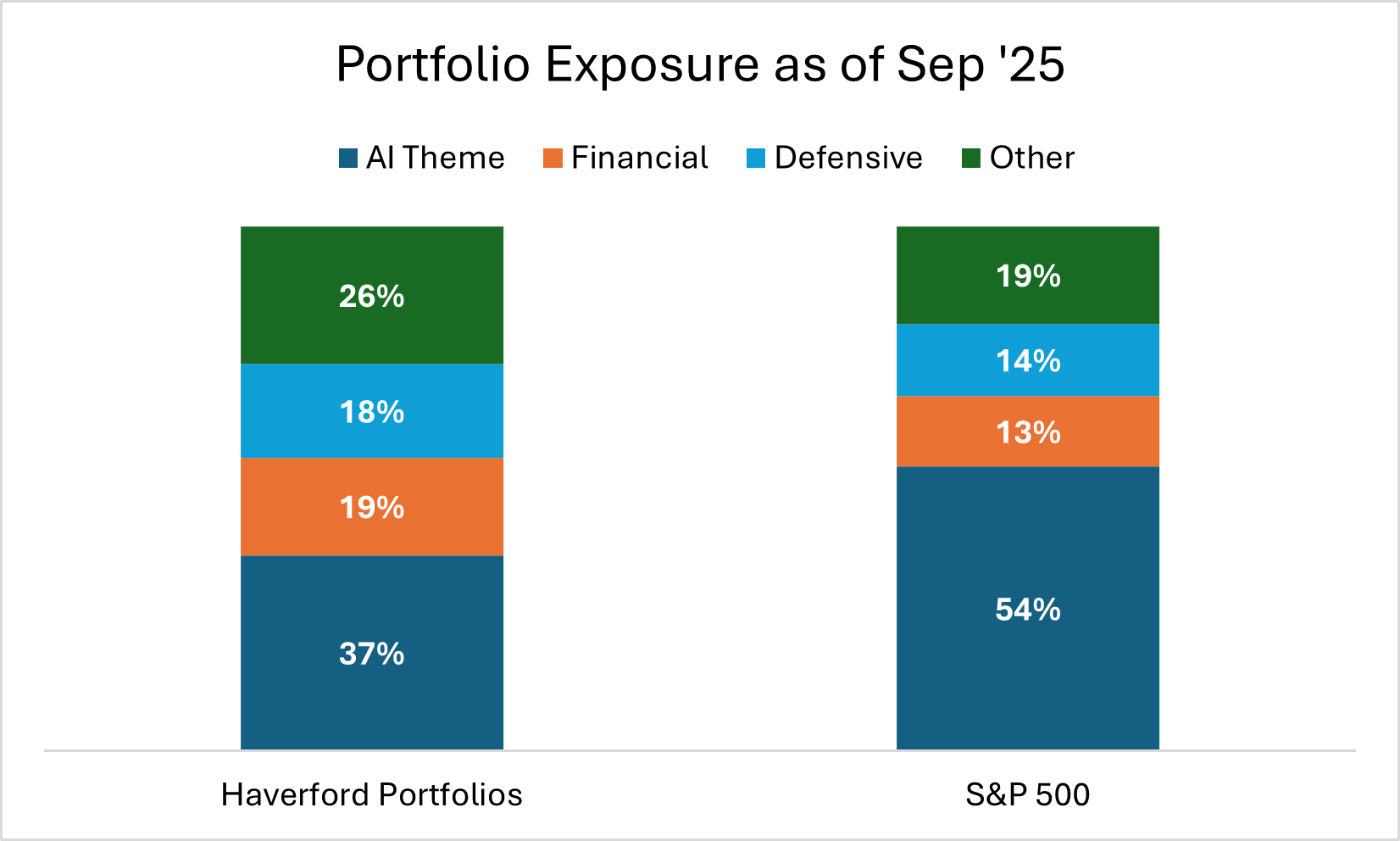
While we believe AI represents a transformative long-term opportunity, we also acknowledge bubble-like dynamics emerging. Our portfolios seek to maintain a healthy, albeit below market exposure to AI leaders, balancing participation in a structural growth opportunity with prudent diversification. Short-term volatility is inherent in markets, especially during periods of rapid innovation and investment. We expect a bear market in these stocks will eventually come, but it might come from much higher levels than today's prices.
We have mapped our portfolios' exposure to different segments of the market. We believe Haverford's mix of exposures relative to AI-adjacent investments is more defensive than the S&P 500 while still providing exposure to growth opportunities. Within our AI exposure we are also focused on managing risk through position sizing and diversified industry exposures. As always, our priority is focused on disciplined risk control while creating lasting value for our clients.
Picture2
Note: Haverford portfolio exposures are approximate based on model portfolios. Actual client portfolios may vary. AI Theme includes exposures across multiple sectors and industries including Tech, Communication, Utilities and Electrical Equipment. Defensive includes Consumer Staples and Health Care. Other includes all other exposure, most notably Aerospace & Defense, Consumer Discretionary, Energy, and Materials. Source: Haverford
Prices in markets, both rational and irrational, are a balancing act of both the positive and pessimistic views. Below is our take on both sides of the AI bubble debate.
Positive View Driving AI Investment Today
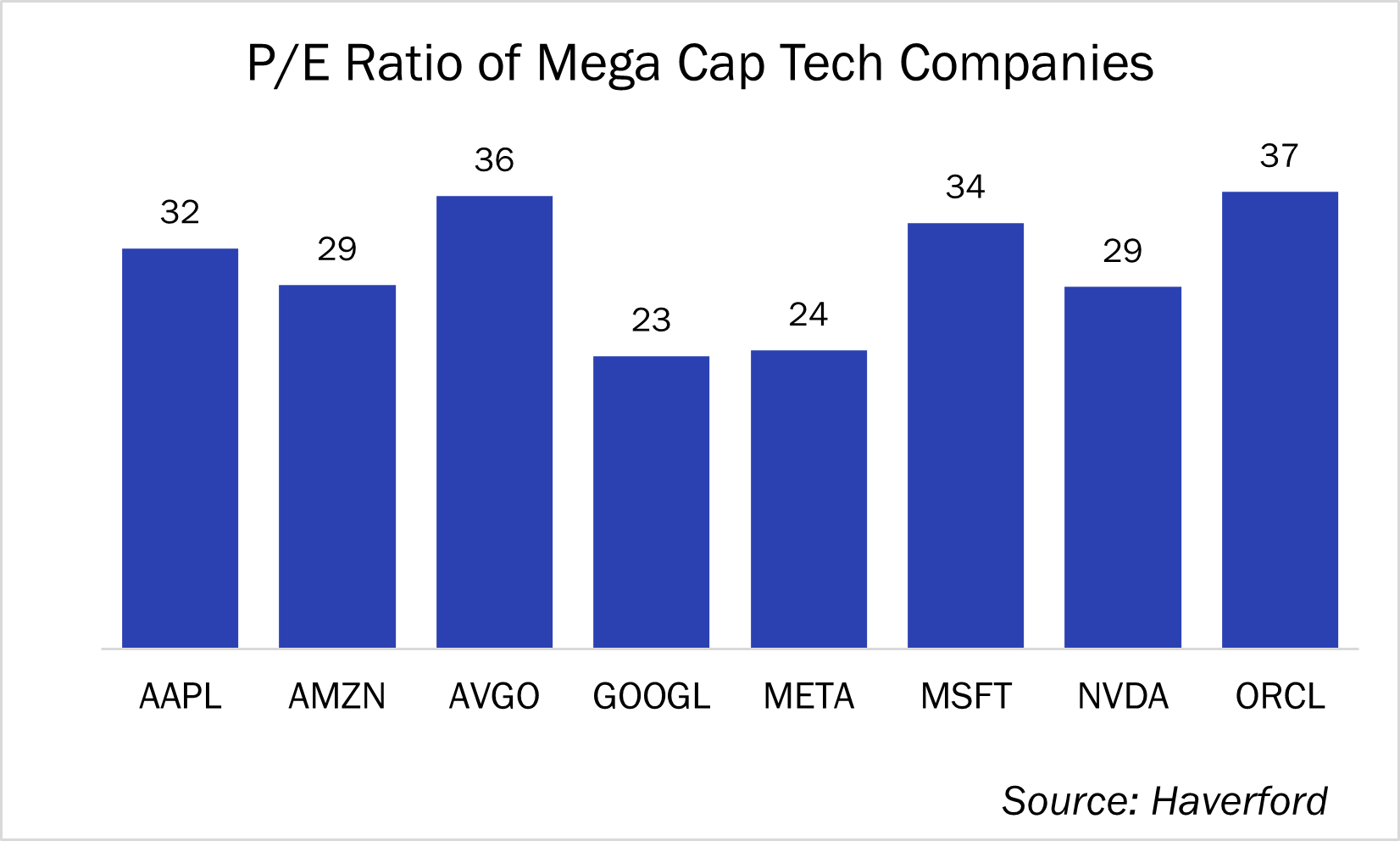
Prices are not that far ahead of fundamentals. The mega-cap tech companies are growing revenues by double-digit rates and trading at earnings multiples of 25-35x. This is not extravagant compared to sectors growing significantly slower. Mega-cap tech has the cash flow to support capex; the real bubble may be in zero-revenue tech start-ups.
AI will become a general-purpose technology like electricity and the internet and will eventually drive productivity in life-changing sectors like Healthcare, Finance, and Energy. AI will eventually be able to optimize electricity grids to prevent outages, assist doctors in diagnosing and treating illness, and drive risk-management and fraud prevention in banking.[1]
Today's AI will be the worst model you use for the rest of your life. AI will only get better, and the rate of improvement has been staggering. The technology is moving so fast it is impossible to predict what new businesses, services, and hopefully time-saving tools it will produce. The internet and mobile computing spawned entire business models and jobs. Uber is an example of a business that was unthinkable before the iPhone, but Uber drivers may soon become a casualty of AI and self-driving cars.
Pessimistic View of AI at Today's Prices
The parabolic AI infrastructure spending is far ahead of monetization opportunities. $500 billion of estimated 2025 capital expenditures will need to generate over $1 trillion in incremental annual revenues just to break even. We have seen no evidence of significant end-user revenue yet being generated. Excess infrastructure investment is nothing new. It occurred in fiber optics in the 1990s, railroads in the 1870s, and the electric grid in the 1920s.[2]
There may be physical constraints to today's planned data center buildouts. The International Energy Agency (IEA) estimates that electricity demand from data centers worldwide is set to more than double by 2030. Driven by AI use, the US economy is set to consume more electricity in 2030 for processing data than for manufacturing all energy-intensive goods combined, including aluminum, steel, cement and chemicals.[3] Data center growth may slow down if consumers see energy prices rise more than the perceived value of their favorite chatbot.
While an argument can be made that Mega cap tech is not that expensive, the bubble is more evident in private-markets. The tech and telecom bubble of the late 90s saw an abundance of IPOs at extreme valuation and sentiment. Today, the IPO market is almost non-existent and private markets are rich with capital. According to the private market investment platform Forge Global, "a basket of seven of the highest-valued private tech companies is now worth $1.3 trillion on paper, almost doubling in the past year."[4] The "fear of missing out" looks to be driving a bidding war for these assets.
Picture3
Source: Haverford
Media Inquiries
Veronica McKee, CMP, CMM
Direct Phone: 610.995.8758
Email: vmckee@haverfordquality.com
Katie Karsh
Direct Phone: 610.755.8682
Email: katie@gobraithwaite.com
Disclosure
These comments are provided as a general market overview and should not be relied upon as a forecast, research or investment advice, and is not a recommendation, offer, or solicitation to buy or sell any securities or to adopt any investment strategy. Opinions expressed are as of the date noted and may change at any time. The information and opinions are derived from proprietary and non-proprietary sources deemed by Haverford to be reliable, but are not necessarily all-inclusive and are not guaranteed as to accuracy. Index returns are presented for informational purposes only. Indices are unmanaged, do not incur fees or expenses, and cannot be invested in directly.
Investments in Securities are Not FDIC Insured · Not Bank Guaranteed · May Lose Value
Related News & Insights
With just days until the U.S. midterm elections, it is nearly impossible to escape the political news cycle. However, election results historically have had less impact on market performance than political candidates would have one believe.

The U.S. equity bull market just turned four years old. One defining characteristic of this bull market, and of growing concern to many investors, is its lack of breadth. Historically, narrow market leadership has often been viewed as a warning sign, raising concerns that the market’s foundation may be weaker than headline index returns suggest.

Investors are navigating a market environment increasingly shaped by a sequence of interconnected forces. Geopolitical tensions are keeping energy prices high. Rising energy prices are contributing to persistent inflation pressures. Elevated inflation is keeping the Fed hawkish and contributing to higher Treasury yields. But despite these headwinds, the U.S. economy continues to demonstrate resilience.
