

Timothy A. Hoyle, Chief Investment Officer
thoyle@haverfordquality.com
The Fed's Credibility Test
The Federal Reserve's latest rate hike was not simply about inflation. Chairman Kevin Warsh's reputation for independence was also on the line, with some experts calling the Fed's policy move a "credibility hike." Without the overwhelming pressure of market expectations, would the Fed still have tightened interest rates? We believe yes, and an analysis of some of Warsh's most meaningful recent remarks provides insight.
Inflation is the Fed's top concern
During his September press conference, Chairman Warsh emphasized that policymakers are focused on acting against inflation "on a timelier basis" rather than waiting for price pressures to become embedded in the economy. If there was any remaining doubt that the Fed is currently more focused on inflation over employment, Warsh's comments were clear: "Today's policy action will support a timelier return to the Committee's 2 percent goal. This Committee will deliver price stability."
The U.S. economy is stronger than many expected
Fortunately, the labor market provides some cover to allow the Fed to focus on reining in inflation. While the U.S. economy is not adding a significant number of jobs or growing the workforce quickly, continuing jobless claims are below historical averages even as the employment base is larger and the unemployment rate remains near 4%.
U.S. Continued Claims (Insured Unemployment)
September 5, 2024 – September 5, 2026
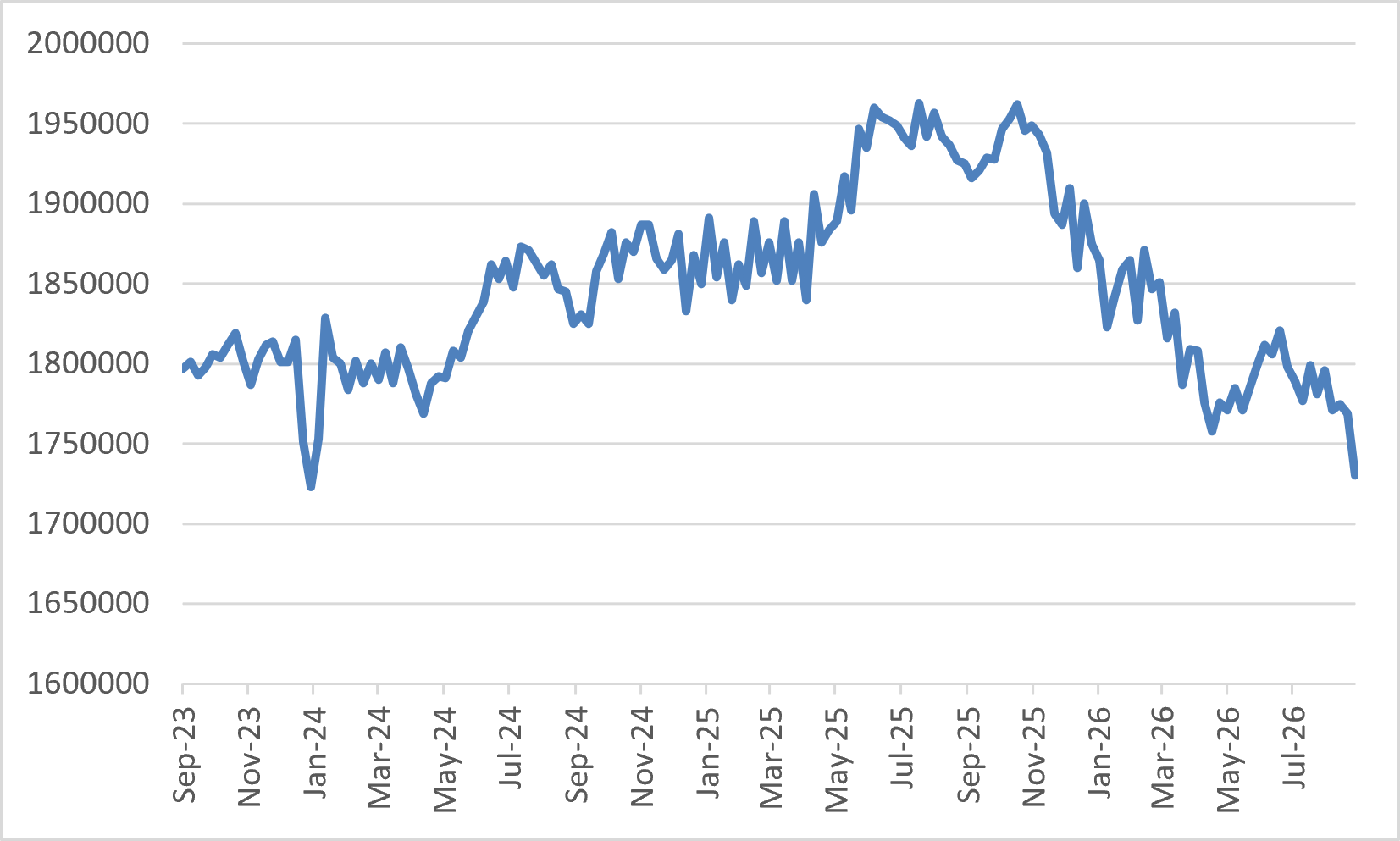
US Continued Claims (Insured Unemployment)
Source: U.S. Employment and Training Administration, FRED.stlouisfed.org
In addition to the jobs market, Warsh painted a surprisingly optimistic picture of economic conditions, highlighting strong productivity gains, robust business investment, and resilient consumer spending. He said the economy continued to perform well despite geopolitical uncertainty and external shocks.
Financial conditions are not restrictive
In one of his most telling comments, Warsh stated, “I would be hard-pressed to describe broad financial conditions as restrictive. This view was widely shared by the committee. So, we removed a dose of accommodation.” This is an important signal because it suggests that the Fed believes there is room to tighten policy further if inflation fails to improve.
The inflation problem is a yield problem
While the Fed moved last week to combat inflation by raising short-term rates, longer rates have been rising since February, measured by the 10-year Treasury yield. In his press conference, Warsh outlined three reasons for rising yields:
“…first is economic strength. Part of the reason why we’ve seen over the course of 2026, long-term yields go up is the economy is strengthened. Second reason, competition for capital. The surge in capital expenditures, which I referenced in my remarks, is real, and the so-called hyperscalers are out in the market raising funding, and so the competition for capital is real and I think it partly explains the increase in yields. The third, is geopolitics. The situation hot spots around the world are driving long-term yields.”
Higher yields affect virtually every asset class, increasing mortgage rates, raising corporate borrowing costs, and pressuring equity valuations. At the same time, the current inflation backdrop features a meaningful supply-side component, aggravated by geopolitics. Supply constraints, limited refinery capacity, and thin inventories are causing diesel prices to surge, and the gap between diesel and gasoline prices to widen. With freight transportation accounting for a significant share of diesel consumption, higher diesel prices have the potential to ripple through supply chains and affect a wide range of goods and services.
U.S. Average On-Highway Diesel Prices
January 1, 2022 – September 18, 2026
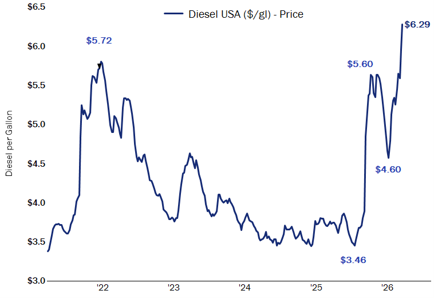
U.S. Average On-Highway Diesel Prices
Source: FactSet
Raising interest rates can suppress demand, but it cannot create additional refining capacity or lower geopolitical risk. However, if energy prices continue to rise, elevated headline inflation likely would influence broader inflation expectations. Hence, the rationale for Warsh’s comments and the Fed’s unanimous vote to raise rates.
Yet, Warsh’s challenge may be larger than managing inflation expectations. He must convince markets that inflation will ultimately move back to target while simultaneously demonstrating that the Fed is acting independently of political pressures. Credibility itself is now part of the policy equation.
Media Inquiries
Veronica McKee, CMP
Direct Phone: 610.995.8758
Email: vmckee@haverfordquality.com
Katie Karsh
Direct Phone: 610.755.8682
Email: katie@gobraithwaite.com
Disclosure
These comments are provided as a general market overview and should not be relied upon as a forecast, research or investment advice, and is not a recommendation, offer, or solicitation to buy or sell any securities or to adopt any investment strategy. Opinions expressed are as of the date noted and may change at any time. The information and opinions are derived from proprietary and non-proprietary sources deemed by Haverford to be reliable, but are not necessarily all-inclusive and are not guaranteed as to accuracy. Index returns are presented for informational purposes only. Indices are unmanaged, do not incur fees or expenses, and cannot be invested in directly.
Investments in Securities are Not FDIC Insured · Not Bank Guaranteed · May Lose Value
Related News & Insights
Timothy A. Hoyle, Chief Investment Officer thoyle@haverfordquality.com The Fed's Credibility Test The Federal Reserve's [...]
The hype in Artificial Intelligence (AI), what many say, is a modern-day gold rush, is amassing trillions of dollars of investment. A recent UN Trade and Development (UNCTAD) report projects the global AI market will grow from $189 billion in 2023 to $4.8 trillion by 2033; massive gains and insatiable demand is being seen in all corners of the industry.
John F. Thomas, CFA Vice President, Fixed Income Portfolio Manager jthomas@haverfordquality.com Hut, Hut, Hike? [...]
