


Maxine Cuffe
Vice President, Director of Global Strategies
mcuffe@haverfordquality.com
Halie W. O’Shea
Vice President, Director of Research
hoshea@haverfordquality.com
U.S. Debt and Deficits: Is It Time to Worry?
Two of the main headwinds facing U.S. equity markets are inflation and rising long-term interest rates. While inflation remains sticky, the most recent Consumer Price Index (CPI) data showed some easing in price pressures. However, attention has increased on the Treasury yield curve, and by extension, what interest rates and the scale of U.S. Treasury debt issuance are signaling about America’s fiscal health.
Last week, Fitch Ratings reaffirmed the U.S. credit rating at AA+. On the surface, this announcement would typically be considered a clear win for the U.S. and its economy. The rating action commentary announced “the United States’ ‘AA+’ rating is supported by its large economy, high per-capita income, dynamic business environment, and exceptional financing flexibility due to the U.S. dollar’s role as the preeminent global reserve currency.” Below the surface, things are a little murkier as the rating decision renewed concerns over ballooning U.S. debt.
The Fitch announcement cautioned that “high fiscal deficits, a substantial interest burden, and high and rising government debt levels constrain the rating.” U.S. Treasury debt levels remain more than double the median for AA-rated sovereign debt while the government has taken no significant action to meaningfully lower its fiscal deficit. Adding to the concerns, the U.S. Monthly Treasury Statement reported that the July deficit reached $432 billion, a level not seen since March 2021, while the year-to-date gap rose to $1.8 trillion.
To fund the growing deficit, outstanding U.S. Treasury debt is accelerating, quickly closing in on $40 trillion. Unfortunately, a good portion of the deficit increase is coming from the debt itself due to higher interest rates. In other words, as debt is maturing, it is rolling over at a higher interest rate, which in turn adds to deficit financing costs.
This chart shows the maturity schedule of all outstanding Treasury debt. Within the next three years, almost half of U.S. debt will need to be refinanced, most likely at higher interest rates.
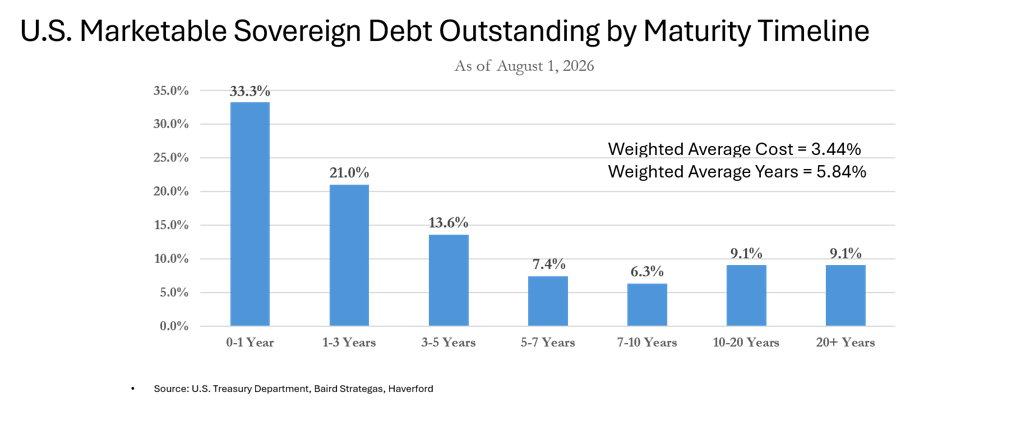
August 19 market comm chart
Source: U.S Treasury Department, Baird Strategas, Haverford
However, given the size and strength of the U.S. economy, we believe this debt refinancing transition can occur in a manageable way. The U.S. can sustain larger deficits than other countries because it borrows in its own currency, controls the world’s reserve currency, has the deepest and most liquid capital markets, and remains the primary safe-haven destination for global savings. This privileged position is unlikely to change anytime soon. Unless there is a large unforeseen shock, such as a major failure of a financial institution in or outside the U.S., we do not believe investors need to be overly concerned today about the rising U.S. debt level.
Furthermore, the recent U.S. intervention in the Japanese yen market indicates the Treasury Department’s commitment to promoting a stable market for its debt. We believe the Treasury will continue to be cautious in terms of avoiding anything that would unduly rattle the market. The Federal Reserve (Fed) also appears to be working in tandem with the Treasury to help ensure a stable financial system through which monetary policy can work effectively. We think it is a good sign that there is cooperation between the Fed and the Treasury in this kind of environment and further reason for investors not to panic at this time.
Media Inquiries
Veronica McKee, CMP
Direct Phone: 610.995.8758
Email: vmckee@haverfordquality.com
Katie Karsh
Direct Phone: 610.755.8682
Email: katie@gobraithwaite.com
Disclosure
These comments are provided as a general market overview and should not be relied upon as a forecast, research or investment advice, and is not a recommendation, offer, or solicitation to buy or sell any securities or to adopt any investment strategy. Opinions expressed are as of the date noted and may change at any time. The information and opinions are derived from proprietary and non-proprietary sources deemed by Haverford to be reliable, but are not necessarily all-inclusive and are not guaranteed as to accuracy. Index returns are presented for informational purposes only. Indices are unmanaged, do not incur fees or expenses, and cannot be invested in directly.
Investments in Securities are Not FDIC Insured · Not Bank Guaranteed · May Lose Value
Related News & Insights

During the third quarter of 2025, the S&P 500 rose nearly 8%, recorded 24 all-time high closes, and was never down more than 2%. Heading into the final quarter of the year we anticipate three major trends from the third quarter will continue to power the market’s steady ascension.

Jason Salmon, CFP®, CSS, Wealth Planner jsalmon@haverfordquality.com 5 Things to Consider for Medicare Open [...]

Timothy A. Hoyle, Chief Investment Officer thoyle@haverfordquality.com The Fed's Credibility Test The Federal Reserve's [...]
