

Resilience Under Pressure: Navigating Higher Rates, Inflation, and the AI Boom
Tim Hoyle, Chief Investment Officer
thoyle@haverfordquality.com
Entering the final months of 2026, investors are navigating a market environment increasingly shaped by a sequence of interconnected forces. Geopolitical tensions are keeping energy prices high. Rising oil and diesel prices are contributing to persistent inflation pressures. Elevated inflation is keeping the Federal Reserve (Fed) hawkish and contributing to higher Treasury yields.
Despite these headwinds, the U.S. economy continues to demonstrate resilience. High gas prices and slumping sentiment have yet to deter consumers from spending. Earnings remain strong across a broad array of companies and sectors, and the AI investment boom continues to provide meaningful support to economic activity. Strong earnings growth has propelled the market higher even as valuation multiples have contracted. Two of the key challenges investors face are whether the current level and growth of earnings are sustainable and whether the data center buildout will introduce greater cyclicality.
Significance of 10-Year Treasury Yields above 5%
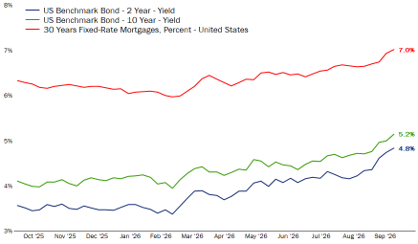
The most important development in financial markets may be the significant move in the U.S. 10-year Treasury yield above 5% to reach levels not seen in over 20 years. In his recent remarks, Fed Chair Kevin Warsh cited three reasons for rising yields: geopolitics, which is one of the driving forces behind high oil prices; stronger-than-expected economic growth; and increasing competition for capital as hyperscalers issue debt to finance the AI infrastructure race. For years, economists have speculated whether increased government borrowing would crowd out private investment. Now, the reverse seems true. Voracious private sector demand for credit by AI issuers is possibly crowding out other borrowers.
Comparison of U.S. Treasury Yields and 30-Year Fixed-Rate Mortgages
September 30, 2025 – September 25, 2026
2026 Fall Outlook_Yield Comparison
Sources: FactSet, Haverford
A sustained rise in the 10-year Treasury yield above 5.25% may pose several risks for financial markets and the economy. Not only do borrowing costs rise, potentially slowing housing activity, capital spending, and economic growth, but higher yields can increase the discount rate applied to future cash flows, placing downward pressure on equity valuations. Equities should be able to withstand higher yields as long as earnings growth remains robust, but investors should be on notice that the risk-reward landscape is becoming marginally less favorable. If inflation continues unabated, yields continue to rise, or earnings begin to deteriorate, Treasuries may compete more directly with stocks for investor capital.
An Inflation Battle on Two Fronts
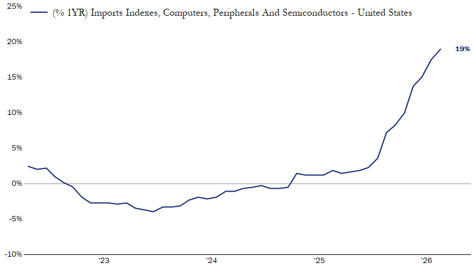
The Fed usually fights price pressures on one of two fronts: overcoming supply-side disruptions or battling overheating demand. Currently, the Fed is contending with both issues as geopolitics are contributing to an energy-related supply shock while demand for AI componentry is spiking.
AI Capex Boom: Growth Engine or Inflation Driver?
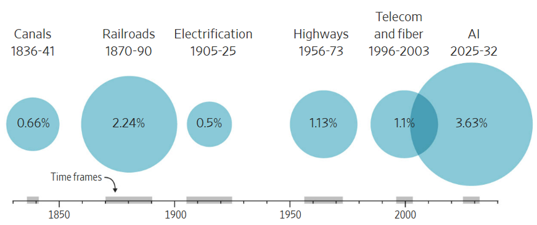
Artificial intelligence is the defining economic theme of this cycle. The scale of the AI buildout is unprecedented as it is on pace to become the largest infrastructure investment wave in U.S. history. According to J.P. Morgan, hyperscaler capital expenditures (capex) could exceed $800 billion in 2026, which is approximately 10 times the amount spent in 2019.1 Economist Stijn van Nieuwerburgh estimates that spending on data centers and related AI infrastructure could reach $10.3 trillion between 2025 and 2032, equivalent to an extraordinary 3.6% of U.S. gross domestic product (GDP) annually.2
Major U.S. Infrastructure Project as Average Annual % of GDP
As of September 25, 2026
2026 Fall Outlook_Major US Infrastructure comparison
Sources: The Wall Street Journal; Stijn Van Nieuwerburgh, “Financing the AI Buildout,” Brookings Institution, September 2026
The AI investment surge is supporting economic growth, but it is also creating substantial demand for labor, power, commodities, and financing. This extraordinary demand is contributing to inflationary pressures that are proving difficult for policymakers to ignore.
Import Prices for Computers, Peripherals, and Semiconductors
% Change from a year earlier; January 1, 2023 – August 31, 2026
2026 Fall Outlook_AI Inflation 2
Sources: FactSet, Haverford
Surging Oil Prices
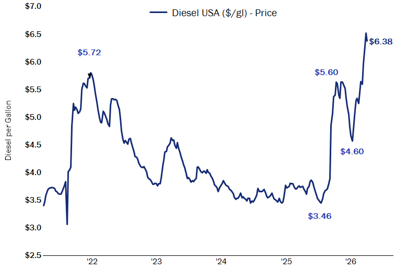
On the supply side of the equation, geopolitical events have constrained oil supplies and refining capacity, with prices again hovering around $100 per barrel. Diesel costs have moved even more dramatically, reaching record highs amid refinery outages and low inventories. Additionally, rising U.S. exports to Europe are limiting domestic supply. High gasoline prices impact consumers directly, but the impact of surging diesel prices may be more extensive, given diesel’s importance as a key input in shipping, agriculture, construction, and other industries.
U.S. Diesel Prices
$/gallon; January 1, 2022 – October 1, 2026
2026 Fall Outlook_Diesel Prices
Sources: FactSet, Haverford
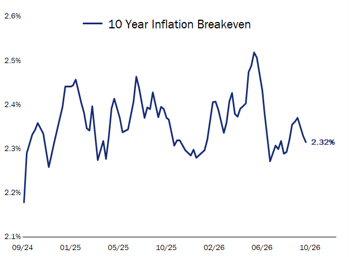
Monetary policy has its limitations. While rate hikes can dampen demand, monetary policy cannot create additional refining capacity or lower geopolitical risk. Fortunately, despite rising yields and oil prices, inflation expectations remain relatively contained, suggesting investors are not yet pricing in a lasting inflation spiral. The Fed would like to keep it that way, evidenced by the September rate hike. As Fed Chair Warsh stated in his September press conference, “We aim to ensure that credit and financial conditions are consistent over time with our mandate, that relative price changes in some sectors of the economy do not broaden, that inflation compensation in market prices stays low, and that inflation expectations remain well anchored.”
U.S. 10-Year Breakeven Inflation Rate
%; 10-Year Treasury Securities vs. 10-Year Treasury Inflation-Indexed Securities; September 24, 2024 – September 25, 2026
2026 Fall Outlook_10-Yr Inflation Breakeven
Sources: FactSet, Haverford
Is the Market Underestimating the Fed?
The September Fed meeting delivered an important message: policymakers still view financial conditions as accommodative, suggesting that additional rate hikes may be necessary to create the restrictive conditions required to bring inflation back to target. Presently, the economy appears capable of withstanding higher rates because many of today’s key growth drivers—most notably AI-related investment and infrastructure spending—are less sensitive to borrowing costs. At the same time, the Fed has become less transparent. Rather than relying on explicit forward guidance, market participants will need to make assumptions for themselves. Based on the two-year Treasury trading at nearly 5%, the market has announced that more Fed rate hikes are likely coming.
Election Uncertainty and Market Volatility
Election years often create uncertainty, and 2026 is unfolding largely as expected. Uncertainty rises as investors debate potential policy changes, including taxes, fiscal spending, regulation, trade, and geopolitics. As uncertainty rises, market volatility typically follows.
Markets often struggle to price political outcomes before they are known. Once the election outcome becomes clearer, however, investors usually shift their focus back to fundamentals. While the House will almost certainly flip to a Democratic majority, the odds for the Senate remain 50/50. A Democrat Congressional majority is likely to bring headline risk to the AI buildout, however, we believe that data center builds will ultimately continue largely unabated.
Implications for Investors
The economy remains fundamentally strong. The key drivers of asset prices—corporate earnings, AI-related investment, consumer spending, and employment—continue to provide meaningful support. While these strengths are widely recognized by the market, leaving limited room for disappointment, investor sentiment reflects a healthy degree of skepticism.
History shows that periods of significant economic and technological change rarely unfold without setbacks. The current environment is no exception, given the scale of the AI-driven capex cycle and the high expectations for productivity gains and future profitability. Some level of disappointment is inevitable.
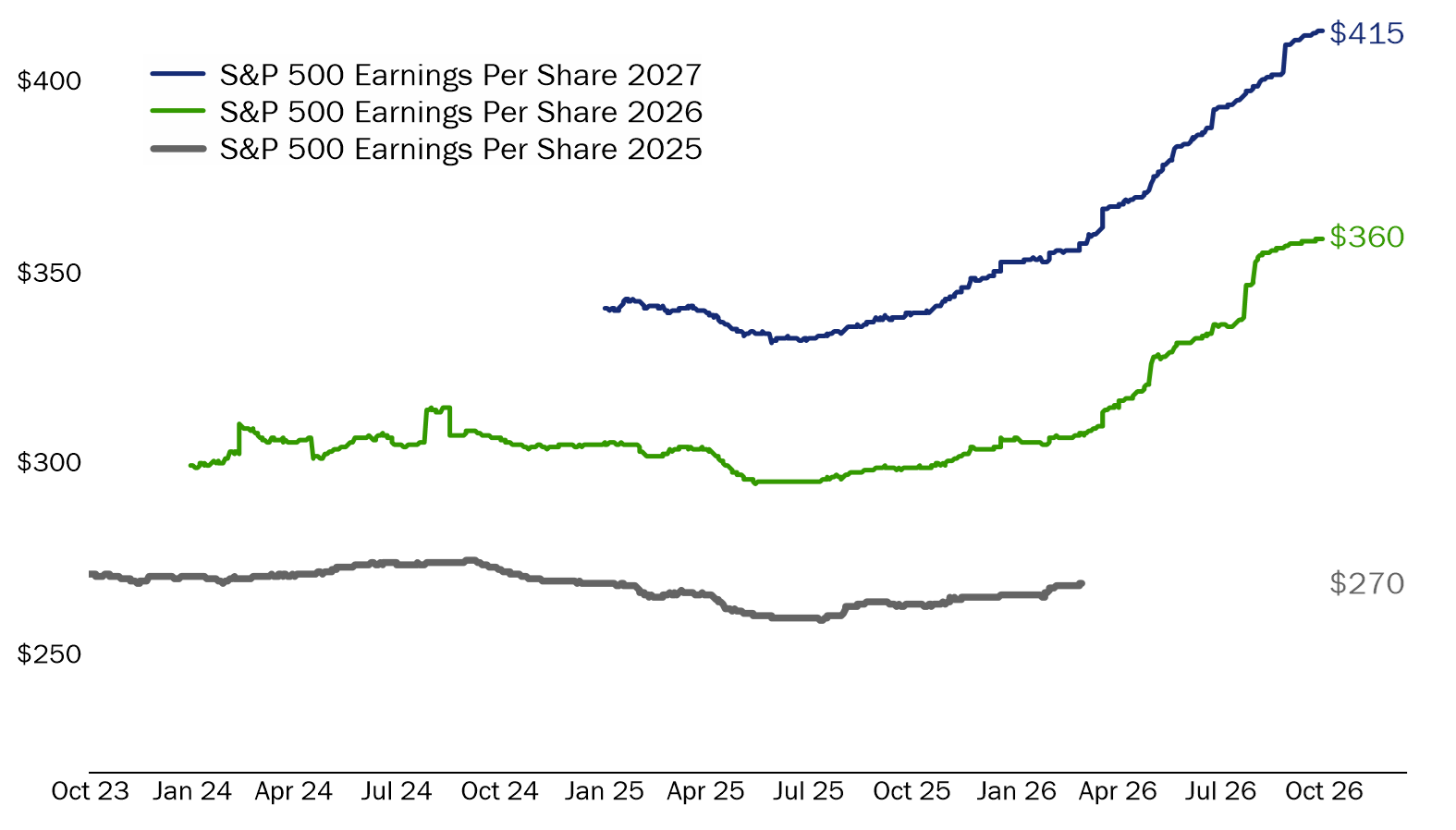
Encouragingly, strong earnings growth has been accompanied by a compression in valuation multiples rather than further multiple expansion. This shift could provide an important cushion if expectations prove too optimistic. At the same time, investors can no longer rely on a market environment in which declining interest rates automatically support asset prices. Higher rates and tighter financial conditions are once again important factors in valuation and portfolio returns.
Earnings Revisions Have Been Exceptionally Strong
$/share; October 1, 2023 – September 30, 2026
2026 Fall Outlook_Earnings Revisions
Sources: FactSet, Haverford
Investors should brace for volatility through the end of the year. Against a backdrop of higher rates, persistent inflation risks, and political uncertainty, diversification and quality may matter. Haverford believes some investors may benefit from the potential diversification benefits and downside protection that may come from looking beyond hyperscalers and the narrow field of technology leaders to quality businesses with solid fundamentals or dividend-paying stocks.
Key Risks to Watch
- Persistent inflation, particularly from energy markets.
- Further increases in bond yields, especially if inflation expectations become unanchored.
- Consumer weakness resulting from higher fuel costs and slowing labor market conditions.
- A slowdown in AI capital spending or failure of productivity gains to meet expectations.
- Federal Reserve policy error, which may include not responding sufficiently to inflation or tightening into an economy that is already slowing.
- Election uncertainty and deteriorating investor sentiment.
1Stephanie Aliaga, “How much of the AI boom is adding to U.S. growth?”, J.P. Morgan, September 2, 2026
2Stijn Van Nieuwerburgh, “Financing the AI Buildout,” Brookings Papers on Economic Activity, September 24-25, 2026
Media Inquiries
Veronica McKee, CMP
Direct Phone: 610.995.8758
Email: vmckee@haverfordquality.com
Katie Karsh
Direct Phone: 610.755.8682
Email: katie@gobraithwaite.com
Disclosure
These comments are provided as a general market overview and should not be relied upon as a forecast, research or investment advice, and is not a recommendation, offer, or solicitation to buy or sell any securities or to adopt any investment strategy. Opinions expressed are as of the date noted and may change at any time. The information and opinions are derived from proprietary and non-proprietary sources deemed by Haverford to be reliable, but are not necessarily all-inclusive and are not guaranteed as to accuracy. Index returns are presented for informational purposes only. Indices are unmanaged, do not incur fees or expenses, and cannot be invested in directly.
Investments in Securities are Not FDIC Insured · Not Bank Guaranteed · May Lose Value
Related News & Insights

During the third quarter of 2025, the S&P 500 rose nearly 8%, recorded 24 all-time high closes, and was never down more than 2%. Heading into the final quarter of the year we anticipate three major trends from the third quarter will continue to power the market’s steady ascension.

Jason Salmon, CFP®, CSS, Wealth Planner jsalmon@haverfordquality.com 5 Things to Consider for Medicare Open [...]

Timothy A. Hoyle, Chief Investment Officer thoyle@haverfordquality.com The Fed's Credibility Test The Federal Reserve's [...]
