

Timothy A. Hoyle, Chief Investment Officer
thoyle@haverfordquality.com
Halie W. O’Shea, Vice President, Director of Research
hoshea@haverfordquality.com
U.S. Retailers Still Sold on the Consumer
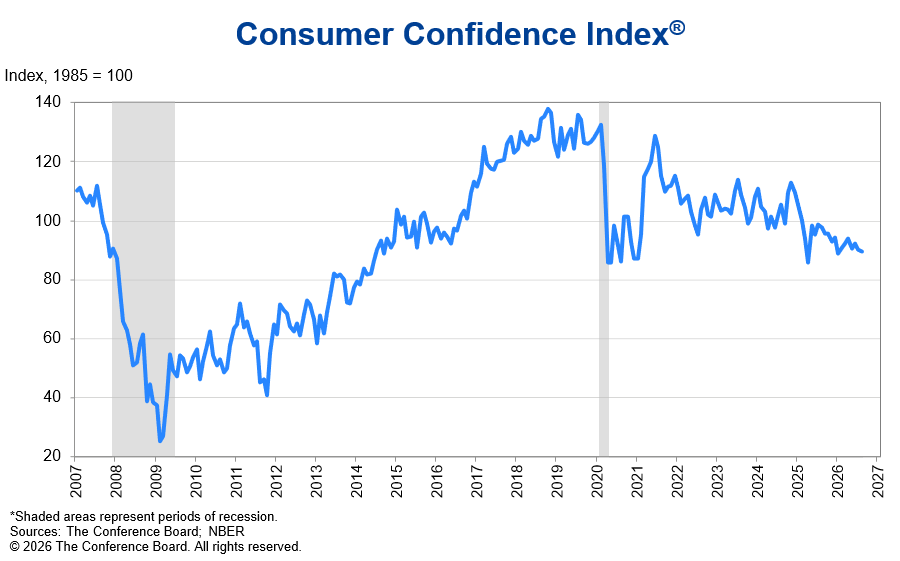
Last week’s earnings results from several major retailers gave an important fresh look into how U.S. consumers may be feeling—and spending. Recently, sentiment has been a fickle gauge, with consumers reporting sinking confidence even as they continue to spend, travel, and enjoy leisure activities. The major retailers generally confirmed the view of steady consumer spending, reporting solid results. However, as expected, there were some signs of consumers becoming more cautious.
cci-aug-2026-1
Sources: The Conference Board; NBER
Two factors working in tandem to influence consumer psychology are high interest rates and rising energy prices, while above-target inflation has had a related impact. Last week, retailers echoed these concerns. Walmart reported a 2.6% increase in U.S. same-store sales, which fell short of analyst estimates and represented the retailer's slowest growth rate in more than six years. Walmart Executive Vice President and Chief Financial Officer John David Rainey emphasized that the company was raising guidance "in the face of more than $2 billion of incremental cost tied to higher fuel prices in arguably a softer consumer environment," adding that "it's prudent to remain cautious by only raising the guide modestly." He referenced "seeing some incremental pressure on the consumer relative to the beginning of the year with higher fuel prices. As you go through month-by-month in the last quarter, you can tell when fuel prices increase and got above $4, and perhaps there's a psychological impact to that, that there are choices that consumers are making."
Caution was also a recurring theme on Lowe's earnings call. Lowe's Chairman, President, and Chief Executive Officer Marvin Ellison stated that "customers continue to tell us that they're being cautious about their spending and prioritizing where and when they invest in their homes." He added, "And it's not just about fuel prices. Fuel prices make up roughly 2% of their annual spend, but it's a combination of fuel prices, geopolitical events, and other uncertain things in the macro." According to Lowe's Executive Vice President Joseph McFarland, "This is leading to consistently smaller projects focused on repair and maintenance needs rather than larger remodeling jobs." Home Depot reiterated a similar sentiment with Executive Vice President and Chief Financial Officer Richard McPhail stating that "consumer uncertainty and housing affordability continue to pressure demand for larger home improvement projects."
Overall, these results do not indicate to us that the consumer is falling apart. Employment continues to be healthy while jobless claims remain low. With household income and spending power still intact, overall recession indicators are not signaling a contraction. However, we will be closely watching credit card transaction data and delinquency rates for signs that shoppers may be pulling back or lower-income consumers may be struggling disproportionately.
The earnings calls highlighted how closely tied consumer spending has been to rising oil prices. A resolution to the Iran conflict would go a long way in alleviating the upward pressure on oil prices, which has been a major component of inflation. Despite these pressures, our current view resembles that of Lowe's Marvin Ellison, who emphasized "we don't think the consumer is getting worse. We think it's pretty much the same, but we think it's a healthy consumer that's overly cautious based on all those factors."
Media Inquiries
Veronica McKee, CMP, CMM
Direct Phone: 610.995.8758
Email: vmckee@haverfordquality.com
Katie Karsh
Direct Phone: 610.755.8682
Email: katie@gobraithwaite.com
Disclosure
These comments are provided as a general market overview and should not be relied upon as a forecast, research or investment advice, and is not a recommendation, offer, or solicitation to buy or sell any securities or to adopt any investment strategy. Opinions expressed are as of the date noted and may change at any time. The information and opinions are derived from proprietary and non-proprietary sources deemed by Haverford to be reliable, but are not necessarily all-inclusive and are not guaranteed as to accuracy. Index returns are presented for informational purposes only. Indices are unmanaged, do not incur fees or expenses, and cannot be invested in directly.
Investments in Securities are Not FDIC Insured · Not Bank Guaranteed · May Lose Value
Related News & Insights
With just days until the U.S. midterm elections, it is nearly impossible to escape the political news cycle. However, election results historically have had less impact on market performance than political candidates would have one believe.
The U.S. equity bull market just turned four years old. One defining characteristic of this bull market, and of growing concern to many investors, is its lack of breadth. Historically, narrow market leadership has often been viewed as a warning sign, raising concerns that the market’s foundation may be weaker than headline index returns suggest.
Investors are navigating a market environment increasingly shaped by a sequence of interconnected forces. Geopolitical tensions are keeping energy prices high. Rising energy prices are contributing to persistent inflation pressures. Elevated inflation is keeping the Fed hawkish and contributing to higher Treasury yields. But despite these headwinds, the U.S. economy continues to demonstrate resilience.
